Risk Management: Money Management 2.0 for Binarium

In 2026, the key difference between a beginner and a consistently profitable trader isn’t a “secret strategy” — it’s how well they manage risk. In this article, we’ll break down Money Management 2.0 for trading on Binarium: how to set up risk rules, protect your deposit, and use the TREND promo code bonus.
On Binarium, short trades and a fast market tempo amplify emotions. Without clear capital management rules, you can go from your first deposit to zero very quickly. Proper risk management helps you survive drawdowns and stay in the market long enough for your system to show its real potential.
What a risk management system is in trading
A risk management system is a set of rules that defines in advance:
- what size you enter with on Binarium;
- what percentage of your deposit you’re willing to lose in a single position;
- when you stop trading during a drawdown;
- how you increase size after your account grows.
Simply put, it’s a filter every trading decision must pass through. Without it, any strategy — even a great one — turns into a series of random entries.
The two main goals of Money Management 2.0
If we simplify all theory, money management in trading solves two key tasks:
- Limit losses and prevent destructive drawdowns.
- Optimize risk size per trade so the deposit grows steadily, not in wild swings.
With Money Management 2.0, you look beyond “1–2% of the deposit” and also consider:
- your experience level on Binarium;
- your psychological resilience and reaction to losses;
- your current financial pressure outside the market.
What feels comfortable to a trader with five years of experience can be overwhelming for a beginner. Money Management 2.0 adapts to the person — not to an “average percent.”
Comfortable risk: how to find your trade size
One core principle: the outcome of the next trade is unknown, but your risk size must be known in advance. For Binarium, you can use a simple baseline:
- for beginners — 0.5–1% of the deposit per trade;
- for more experienced traders — 1–2%, up to 3% only for A+ setups.
If clicking “Higher” or “Lower” in the Binarium terminal makes you tense, your risk is already too high. Common overload signals:
- the urge to “sit through” a loss and immediately win it back;
- watching the chart every second, unable to step away;
- heavy fatigue and burnout after a session.
In Money Management 2.0, psychological comfort matters as much as the percent. Discomfort is a clear indicator you’re outside your acceptable risk zone.

A practical Risk Management model for Binarium
Below is an example of a structured risk management system for Binarium. It’s not a rigid regulation — it’s a base template you can adapt.
1. Risk per trade
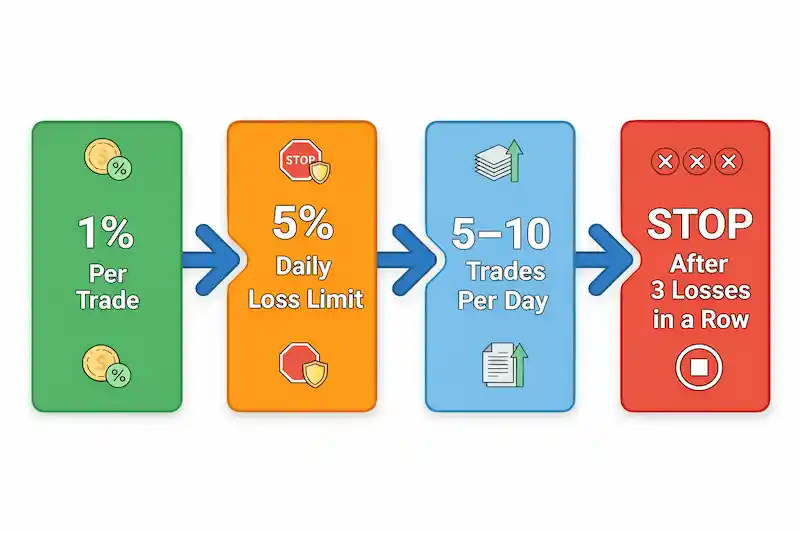
- 1% of the deposit — baseline trade size;
- 2% — maximum, only for setups fully matching your plan.
Example: a $200 deposit → 1% = $2, 2% = $4.
The baseline trade size is $2; in perfect conditions you can temporarily raise it to $4.
2. Daily loss limit
Set a daily drawdown limit, for example 5% of the deposit. Hit −5% — stop trading until the next session. This protects you from impulse decisions and chasing after a losing streak.
3. Trade count limit
For beginners on Binarium, 5–10 trades per day is enough. Quality setups and discipline beat high trade counts.
4. Handling a losing streak
In Money Management 2.0, losses are a normal part of the system. The key is to distinguish:
- normal losses — when you followed the rules;
- toxic losses — caused by emotional entries and upping size “on feelings.”
A simple rule: after three losses in a row, cut risk in half or end the trading day.
Scaling risk: when MM 2.0 allows you to increase size
Money Management 2.0 isn’t only about protecting your deposit — it’s also about increasing size smartly when your system is consistently profitable. Key principle: increase risk only from profit, not from the desire to win back losses.
Example of a dynamic approach:
- Base risk — 1% per trade.
- After +10% deposit growth, raise risk to 1.5%.
- After the next steady +10–15% growth, you can move to 2%.
- If drawdown exceeds 5–7%, return to the previous risk level (or lower).
This approach lets you use strong periods without destroying overall stability on Binarium.
Technique + psychology + risk = consistent trading
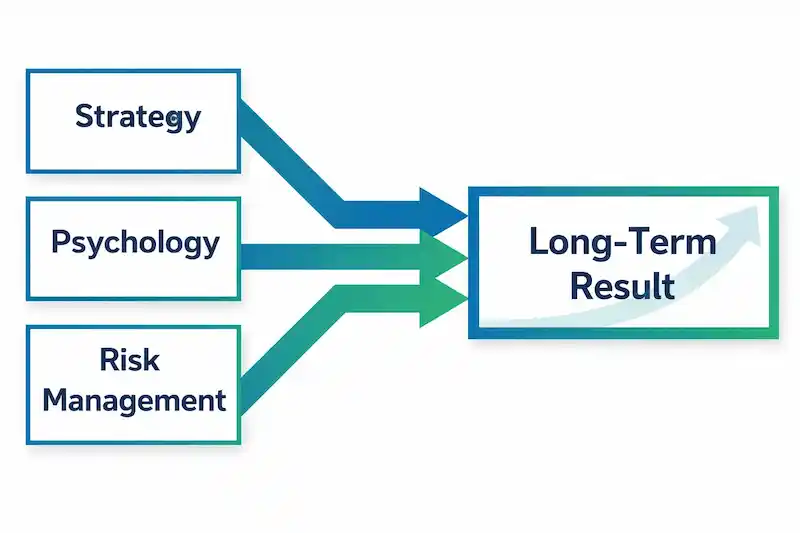
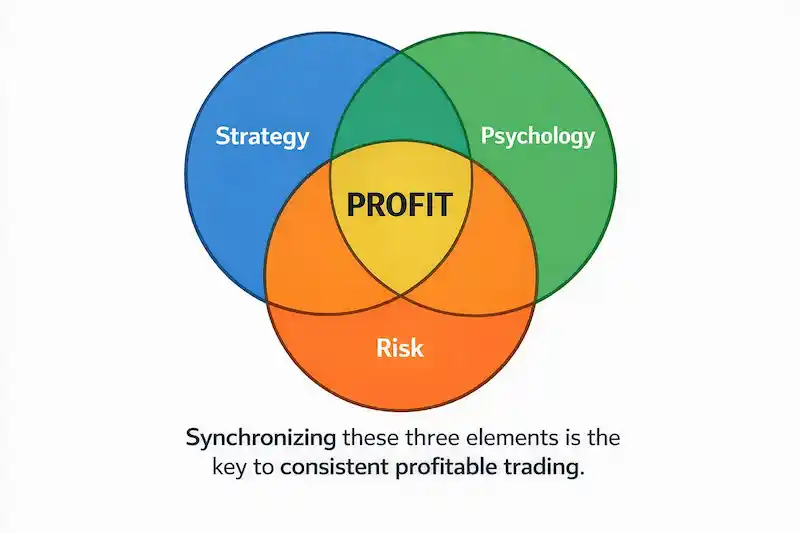
Modern trading is not just an entry strategy — it’s a combination of:
- Technique — a specific trading system (scalping, intraday, etc.).
- Psychology — the ability to handle losing streaks without blowing up the deposit (or abandoning the system).
- Risk management — clear numbers: risk per trade, drawdown limit, trade count.
Remove any one of these elements, and even a perfect setup stops working long-term. Money Management 2.0 combines everything into one coherent, resilient system.
Money Management 2.0 and Binarium: how to apply it in practice
Binarium is convenient for implementing risk management because:
- you plan position size in advance based on your risk percent;
- you control how many trades you take per day;
- you can track stats and account dynamics in the dashboard.
To test money management more comfortably, it helps to have enough “room” on the balance. That’s where a starting bonus can help.
Deposit bonus with promo code TREND
On Binarium, promo code TREND gives +100% on the first deposit. This allows you to:
- start trading with a larger balance;
- test your risk management system across more trades;
- without increasing your own financial risk.
Always check the current bonus terms and turnover requirements in your Binarium account. You can register and activate the bonus via the partner link: go to the Binarium platform.

Where to learn risk management in real practice
Theory is useful, but Money Management 2.0 sticks much faster when you see real examples:
- how a trader reduces risk after a losing streak;
- how they increase size correctly after deposit growth;
- how they distribute trades and risk during a session.
If you don’t want to figure it all out alone, you can join the Telegram channel “Konstantin Gromov’s Trading Expert”. There you’ll find:
- trade breakdowns with a focus on risk and capital management;
- practical money management schemes tailored to Binarium;
- tips on handling drawdowns while keeping your system intact.
Join here: Telegram “Konstantin Gromov’s Trading Expert”.

Summary: how to implement Money Management 2.0 today
A quick checklist to implement a risk management system on Binarium:
- Define a comfortable risk per trade (0.5–2% of the deposit).
- Set a daily loss limit and a trade count limit.
- Write down actions for a losing streak (for example, stop after 3 losses in a row).
- Use a dynamic approach: increase risk only after steady account growth.
- Trade on Binarium while following your Money Management 2.0 rules.
- When depositing, activate promo code TREND to get a +100% bonus and more space to test your system.
- Follow Konstantin Gromov’s Telegram channel to see how risk management works live.
This way, risk management stops being theory and becomes a real working tool that protects your deposit and helps you grow consistently on Binarium.
Ready to apply Money Management 2.0?
Top up your Binarium account and use promo code TREND to get a +100% bonus and test your risk management system.