Head and Shoulders Trading Strategy: A Clear Beginner’s Guide

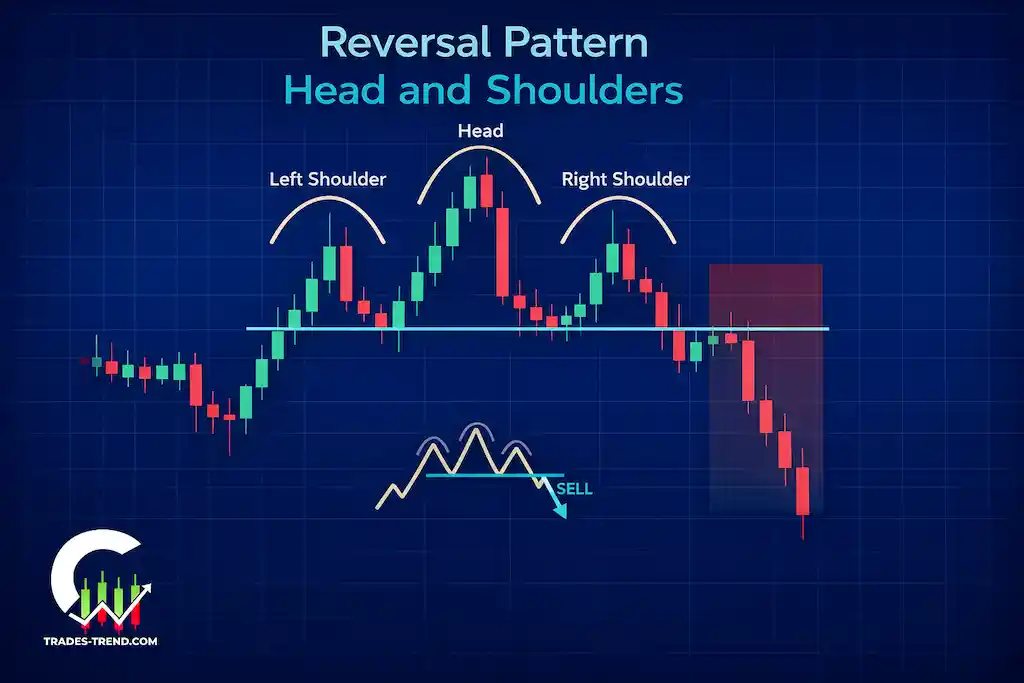
The head and shoulders strategy is built around a classic reversal pattern. The idea is simple: after a trend, the market gradually runs out of steam and price often turns. The key rule is not to guess — wait for a confirmed break of the neckline.
The strategy in 10 lines (quick rules)
- There must be a trend before the pattern forms.
- Identify the left shoulder → head → right shoulder.
- Draw the neckline using the two reaction lows.
- Do nothing until the neckline is broken.
- For beginners, it’s safer to wait for a candle close beyond the neckline or a break + retest.
- Estimate the target as the head height projected from the neckline.
- If price snaps back above the neckline and holds, cancel the setup.
- Skip patterns if the neckline area is choppy (constant wicks through the level).
- Filter weak patterns (see “Filters”).
- Backtest and keep a simple trading journal.
Head and shoulders explained simply
It’s a pattern made of three peaks (or three troughs for the inverse version):
- Left shoulder — price makes a peak and pulls back.
- Head — the next peak is higher, then another pullback.
- Right shoulder — a lower peak than the head (often near the left shoulder level).
- Neckline — a line drawn through the two pullback lows between the peaks.
The meaning: the head is the “last strong push,” and the right shoulder shows weakening momentum.
Pattern anatomy (and how to spot it correctly)
The pattern has 4 must-have elements:
- Left shoulder — first peak and pullback.
- Head — a higher peak and another pullback.
- Right shoulder — a peak lower than the head.
- Neckline — a line through the two pullback lows between the peaks.
Important: without a prior trend, it’s often just noise.
The neckline: how to draw it (5 rules)
- Connect the two key lows (between shoulder & head, and between head & shoulder).
- The neckline can be flat or slanted — both are normal.
- Don’t “force” the line to fit a convenient breakout — use obvious swing points.
- If there are many tiny lows clustered together, that’s a sign of chop — a weaker pattern.
- The clearer the neckline looks at a glance, the better.
Key condition: there must be a trend before the pattern
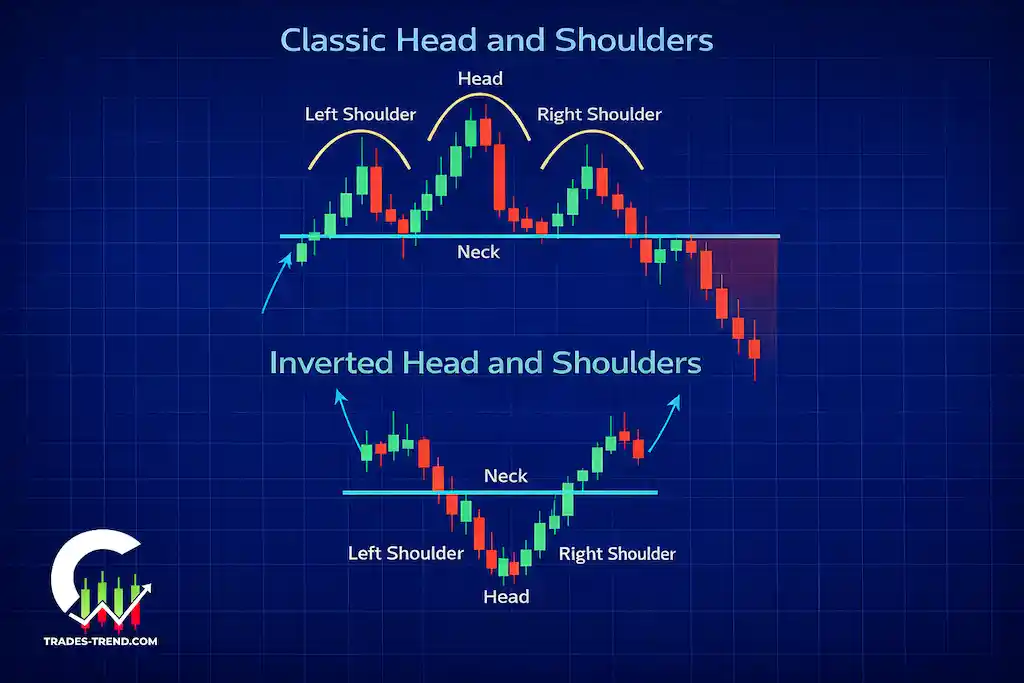
Head and shoulders works as a reversal setup only if there was a trend beforehand:
- for regular H&S — an uptrend before the pattern,
- for inverse H&S — a downtrend before the pattern.
If the pattern forms in a range (price moving back and forth without direction), breakouts are more random.
When the pattern is considered confirmed
Rule #1: don’t trade it until you have confirmation of the neckline break.
Rule #2: for beginners, it’s safer to wait for a candle close or a break + retest.
| Style | Entry condition | Pros | Cons |
|---|---|---|---|
| Aggressive | enter immediately on the neckline break | earlier entry | more false breakouts |
| Balanced | wait for a candle close beyond the neckline | fewer traps | later entry |
| Conservative | break + retest of the neckline | often the best balance | the retest may not happen |
Where is the best place to practice this strategy?
If you want to build skill fast specifically in “confirmation-based” setups, it’s easiest to test on one platform and keep a journal. Register on Binarium and use promo code TREND during signup.
Open an account and claim a bonusHow the target is calculated (no magic)
The H&S target is measured like this: take the distance from the head to the neckline and project it from the breakout point in the direction of the move.
Important: it’s a guideline, not a guarantee. Sometimes price falls short, sometimes it goes further.
When the setup is invalidated (the pattern “breaks”)
Remember these 3 simple markers:
- Price broke the neckline, then snapped back and held on the other side.
- The market turns into chop around the neckline (lots of wicks and back-and-forth).
- The right shoulder and neckline are no longer readable — the structure dissolves.
Filters that genuinely reduce false breakouts
If you want fewer traps, filters are a must:
- There was a trend before the pattern (without it, the setup is weaker).
- The pattern is obvious (don’t “force” it).
- The neckline isn’t in a mess (constant wicks through it = skip).
- The right shoulder size is reasonable (not stretched and not random).
- The breakout looks like a move, not just a poke (that’s why candle close helps).
- If there was a retest, it should hold the level (if it collapses easily, it’s weak).
- Avoid sharp news spikes right at the breakout zone (often create fake moves).
How not to confuse H&S with similar patterns
This helps avoid the mistake “I see head and shoulders everywhere”:
- Double top — two peaks near the same level (no higher head).
- Triple top — three peaks at the same level (no shoulder/head structure).
- Wedge/flag — compression with slanted boundaries, not “neckline + three peaks.”
Chart examples: how to review the pattern
Analyze every case the same way so you don’t rely on “it felt like it”:
- Was there a trend before the pattern?
- Where are the left shoulder / head / right shoulder?
- Where is the neckline (flat or slanted)?
- Was there a break? How was it confirmed (break / close / retest)?
- Where is the target guide (head height)?
- Which filters support or reject the setup?
Live sessions & trade reviews
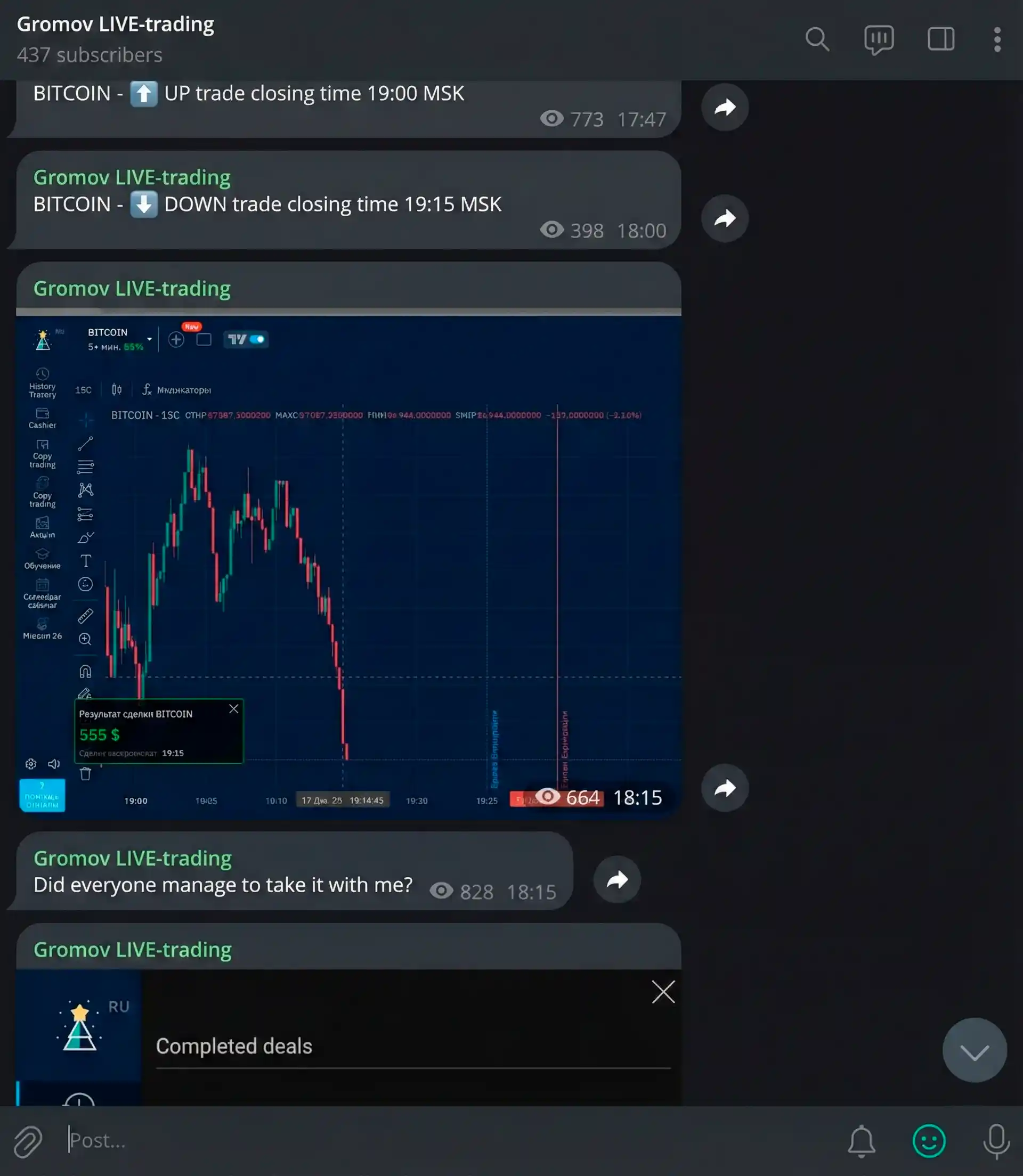
If you’re new but want to start trading actively — I run 2 live trading sessions: a daytime one at 12:00 and an evening one at 18:00 (UTC +3). Access to the group is free. To trade together — set up your account on Binarium with promo code TREND.
Message me on TelegramCommon beginner mistakes (and how to fix them)
- Drawing H&S with no trend → find the trend first, then look for the pattern.
- Acting before the neckline break → wait for confirmation, otherwise it’s guessing.
- Seeing the pattern everywhere → if it isn’t obvious without “stretching,” skip it.
- Ignoring chop around the neckline → in chop, breaks are often random.
- No clear invalidation rules → write down the 3 invalidation markers (see above).
- No journal → without it you can’t tell whether the problem is the strategy or discipline.
How to backtest the strategy (without fooling yourself)
You don’t need “magic win rates.” You need disciplined testing.
Mini plan:
- pick 1–2 markets and 1–2 timeframes,
- find 20–50 patterns in history,
- log the same rules every time (how you confirmed the break, whether there was a retest),
- draw conclusions about pattern quality and filters.
FAQ (short)
1) Is the head and shoulders strategy a 100% reversal?
No. It’s a probability-based setup. The core is breakout confirmation and false-breakout filters.
2) Can I use head and shoulders on any timeframe?
Yes, but smaller timeframes have more noise and stop-runs. Beginners usually learn faster on cleaner charts.
3) What matters more: shoulder symmetry or the neckline break?
Symmetry is rarely perfect. What matters is a clear structure + a valid neckline + confirmation.
4) Is a retest mandatory?
No. It often improves the setup, but sometimes price moves away without a retest — that’s why there are three entry styles.
5) Why do false breakouts happen on the neckline?
Because of ranges, high volatility, spikes, and whipsaw around the level. That’s why it’s better to wait for a close and use filters.
6) What’s the difference with an inverse head and shoulders?
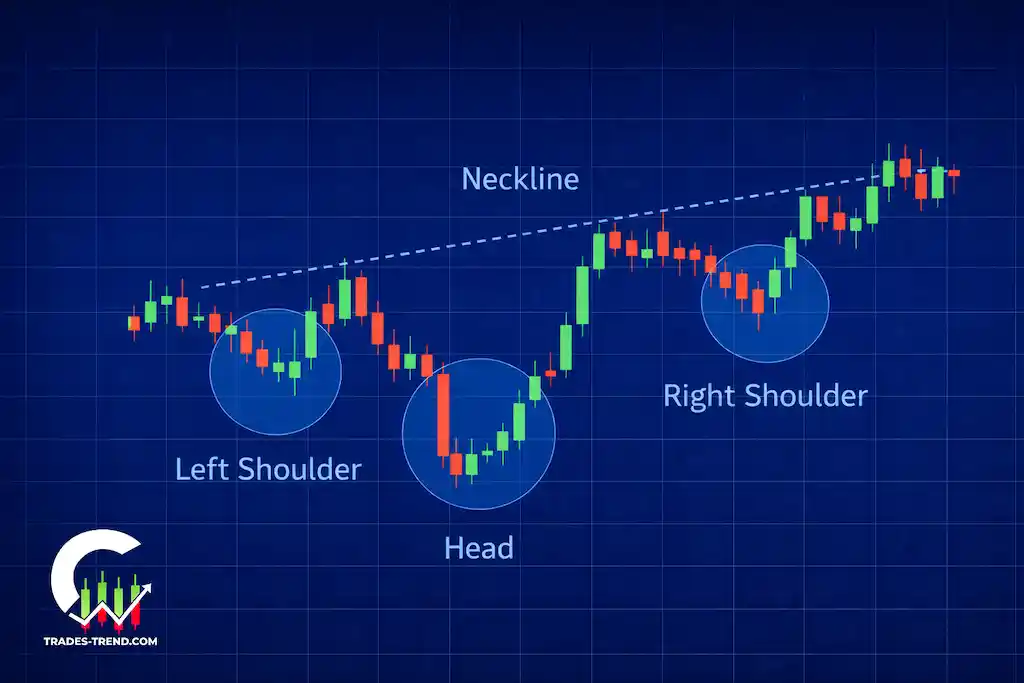
It’s the mirror version: it appears after a downtrend and can signal a reversal upward. Same rules: neckline, confirmation, filters.
Bottom line
Head and shoulders is one of the clearest beginner-friendly strategies — if you stick to the basics:
- look for the pattern after a trend,
- draw the neckline and wait for confirmed breakout,
- use filters to avoid false moves,
- know in advance when the setup is invalidated,
- backtest and keep a journal.
More helpful content on this topic
- Scalping Strategy on Binarium — fast entries, discipline, and common mistakes on lower timeframes.
- What is imbalance and how to use it in trading — how to read order-flow imbalance and avoid confusing momentum with a “spike.”
- Stock trading for beginners: where to start — the basics for anyone just entering the markets.
Ready to put this into practice?
Fund your Binarium account and use promo code TREND to get a +100% bonus and test the strategy.