Imbalance in Trading in Simple Terms

If you’ve ever stared at a chart and thought, “price kind of skipped an area… and then keeps coming back to it,” you’ve already noticed imbalance in trading. In plain English, it’s a price inefficiency: a moment when the market moves so fast it doesn’t properly trade the whole range.
One of the most popular ways to spot that inefficiency on a candlestick chart is the Fair Value Gap. Traders use different names for it: FVG, a gap, a fair value “window,” a market imbalance. Below we’ll break it down clearly: what it is, how to mark it correctly, how to use it in trading, and how it differs from iFVG.
What is imbalance in trading?
Imbalance is a mismatch between buyers and sellers that pushes price with strong momentum. Imagine an auction: if buyers suddenly overwhelm sellers, they “buy through” prices upward, and some levels don’t get normal two-sided trading. On a chart it looks like a fast move and a zone where there were few trades.
Why does it matter? Because markets often seek balance: they come back into that “skipped” area, collect liquidity, and test whether the new level can hold.
Fair Value Gap: what is FVG in trading?
Fair Value Gap (FVG) is a chart area where price moved through a range too quickly and left a “window” between candles. In the classic approach, it’s a 3-candle pattern.
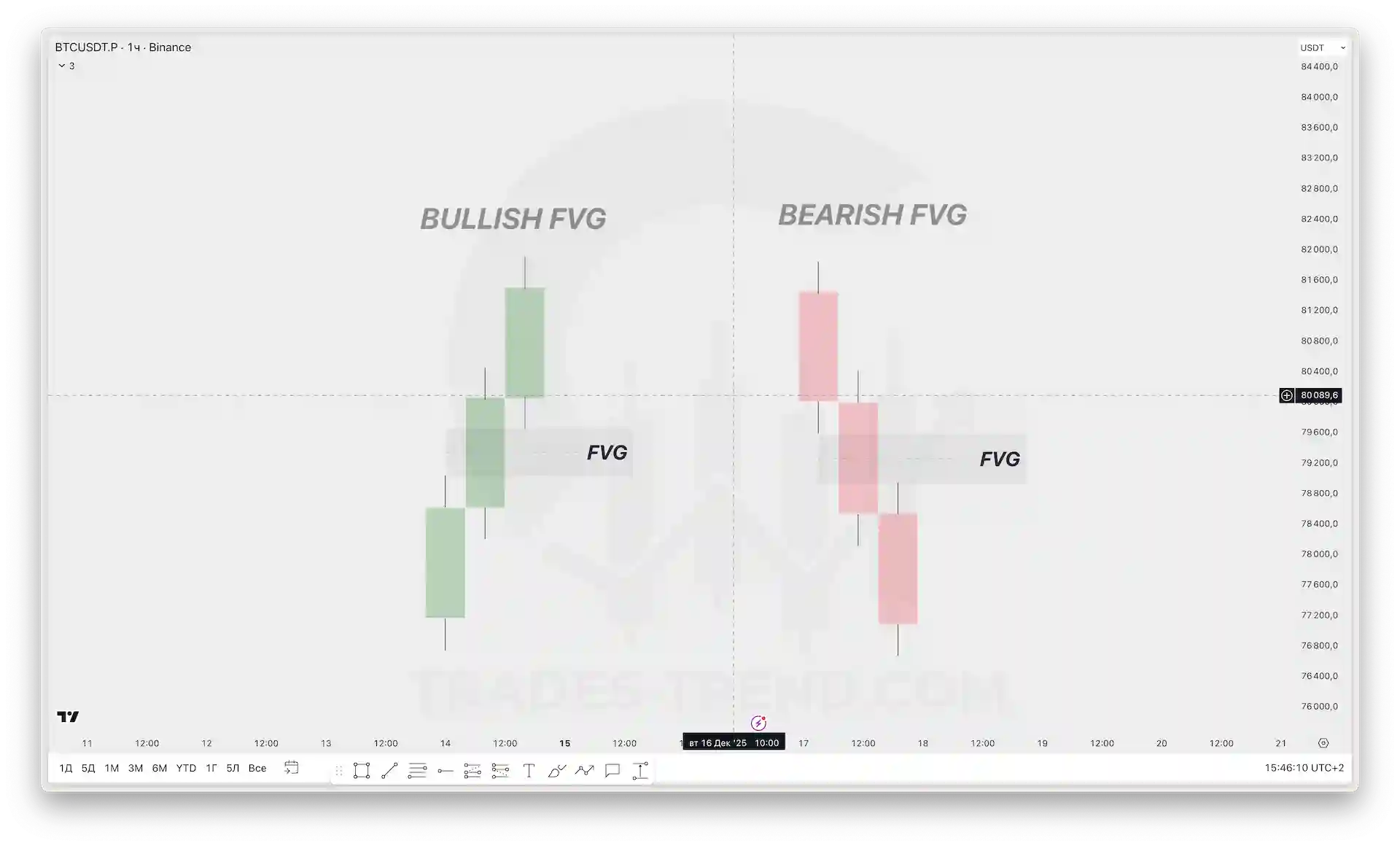
The easiest way to remember it:
Bullish FVG (up)
On an impulse up, a zone forms between the High of the first candle and the Low of the third candle. If the third candle’s Low is above the first candle’s High, you get an “empty space” (inefficiency) between them. That’s the FVG zone.
Bearish FVG (down)
On an impulse down, the zone forms between the Low of the first candle and the High of the third candle, when the third candle’s High is below the first candle’s Low. That’s why FVG is often described as a “hole in fair value” inside a strong move.
Why price returns to an FVG
No magic—three practical reasons that show up in real markets:
Liquidity and large order execution. The impulse may have moved fast, but bigger participants often complete positions on the return.
Post-impulse retest. The market likes to check: was that move real, or just a spike?
Crowd psychology. Beginners often buy the top after a strong impulse. A return into FVG gives “smart money” a chance to push price toward better levels while late buyers chase.
How to mark FVG correctly on a chart
A mini algorithm for beginners:
First, find an impulse—a sharp move with large candles. Then look for the 3-candle structure during that impulse. Mark the FVG zone with a rectangle. After that, wait for price to return into the zone and look for confirmation: a reaction, a reversal candle, or a micro-structure break.
An important nuance
FVG tends to work best when it matches context: market trend and structure, support/resistance, liquidity zones (day high/low, local extremes), and also sessions and news.
How to trade FVG: two simple scenarios
Scenario 1: FVG fill
The idea: price returns into the zone, partially or fully “fills” it, and then continues with the trend.
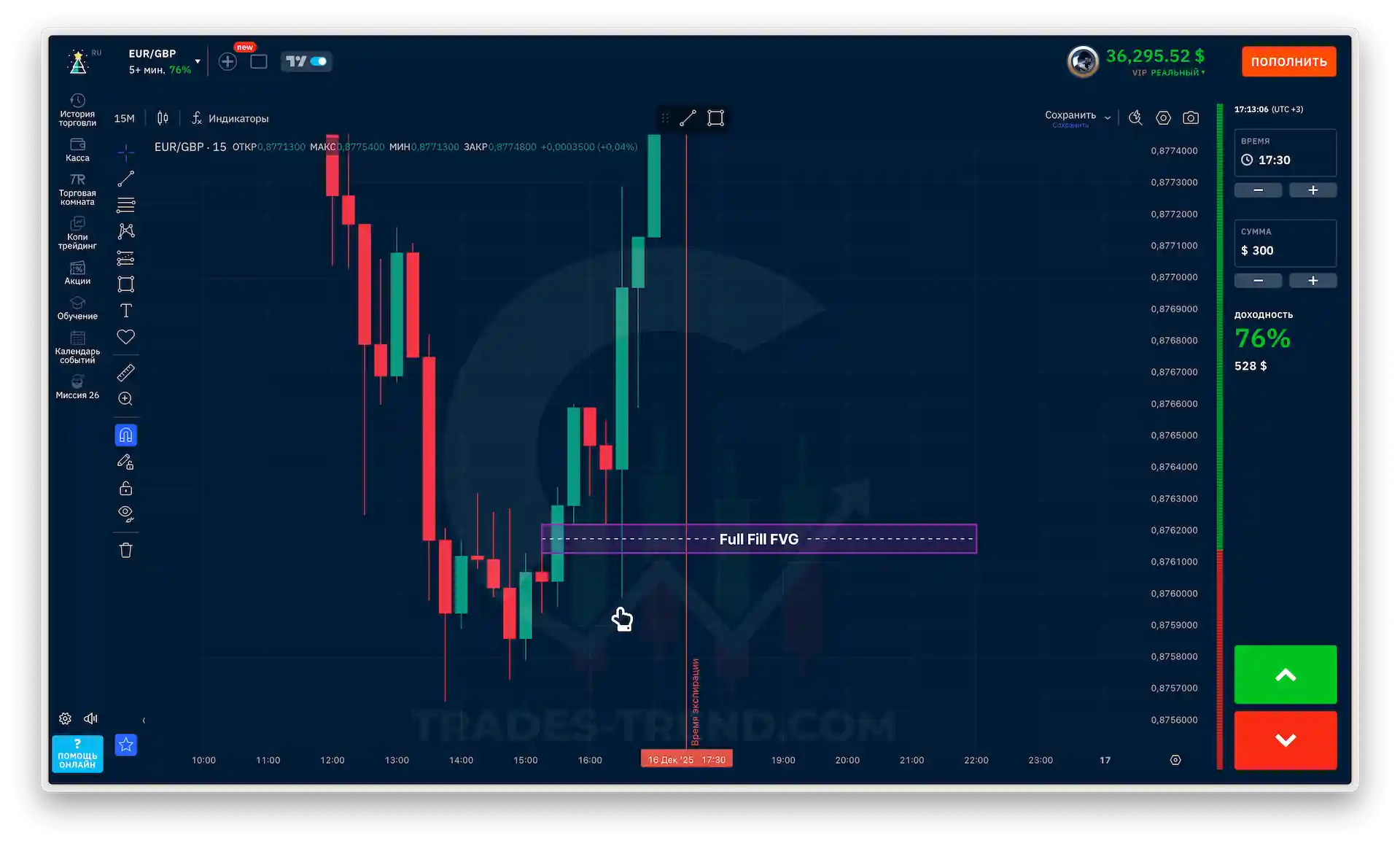
A common approach: enter after the reaction in the zone (for example, a reversal candle), stop-loss—beyond the zone boundary (so noise doesn’t stop you out first), targets—nearby liquidity, a swing extreme, or the next key level.
Scenario 2: reaction from the midpoint (50% FVG)
Many traders don’t focus on the whole rectangle, but on the midpoint of the zone—an approximate “balance” level.
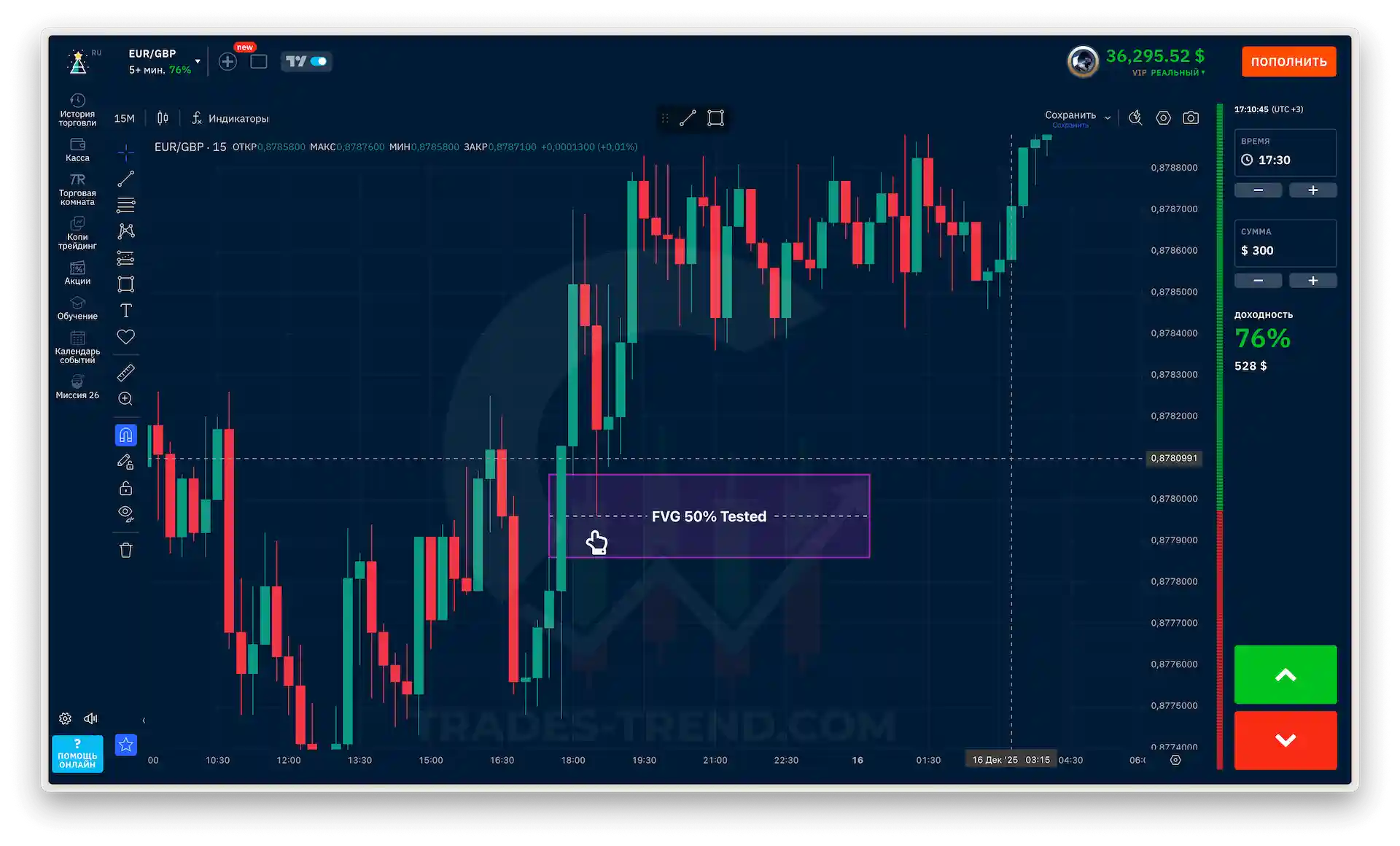
The idea: price often reacts from the midpoint of the range. It’s not a law, but it’s a widely used practical guideline worth keeping in mind.
💡 Want to sharpen the skill in real practice?
The best way to learn FVG is to train your eye on live charts. On Binarium you can use a demo account to practice without risk. When you register, use promo code TREND to get a +100% bonus on your first deposit.
iFVG: what it is and how it differs
Now let’s talk about iFVG. It’s a related tool, but with a different logic.

iFVG (inverse FVG) is usually when an FVG forms, price drives through it, and after acceptance the zone starts working in the opposite direction—as support or resistance.
In simple terms: a regular FVG is a “pullback zone,” while iFVG is a “role-reversal zone” after a clean break.

Quick cheat sheet:
FVG: “we return and react in the direction of the impulse.”
iFVG: “we broke the zone—and now it works the other way.”
Common beginner mistakes with FVG and iFVG
Looking for FVG anywhere. Inefficiency zones inside choppy ranges usually produce noise, not high-quality setups.
Entering without context and confirmation. “Price touched the rectangle—so it must reverse” is not how markets are obliged to behave. You need additional factors.
No risk management. If you want consistency, start with risk control. Without a clear system—like the one I cover in my risk and money management guide—any strategy will eventually hit a losing streak.
Emotions and FOMO. FVG often appears right after an impulse, and it’s tempting to “jump on the train.” That’s where beginners lose money. Work on trading psychology to avoid impulsive decisions.
Checklist: how to use FVG more safely
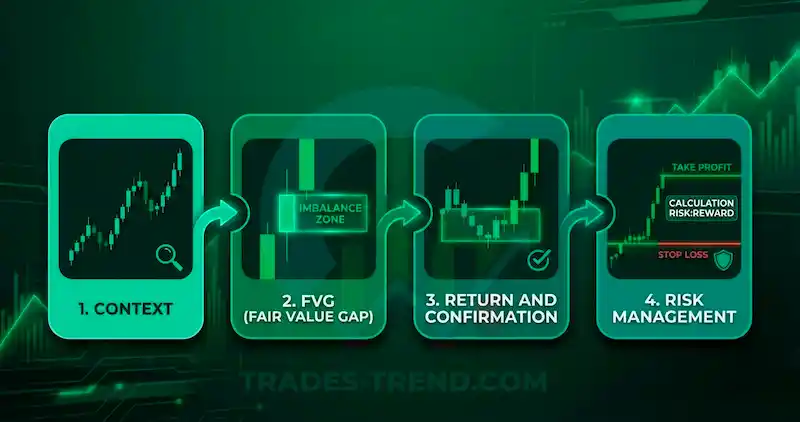
Choose a liquid instrument with decent movement and spread. First define the market direction—structure and trend. Mark FVG after an impulse, not inside chop. Wait for the return and a reaction—that’s your confirmation. Keep risk per trade fixed and small. Track trades in a journal and note which FVG setups truly work.
If terms like structure and liquidity still feel unclear, don’t rush into advanced patterns. Start by building the bigger picture with stock trading basics for beginners, so you approach the market systematically—not randomly.
How to practice effectively
The most effective way to learn Fair Value Gap and iFVG is not to “read 10 more articles,” but to train your eye on charts: mark zones, wait for returns, and collect stats.
For risk-free practice, Binarium is a solid option—there’s a demo balance to train. When you register, use promo code TREND to get a +100% bonus on your first deposit. And remember: trading involves risk, so demo + proper risk management solves half the problems.
Where to get trade breakdowns and support
If you want to build a system faster and not do it alone—join Константин Громов’s Telegram channel. You’ll find free materials, analysis, and trading bots. It’s a handy way to see how an experienced trader reads the market—and where FVG/iFVG makes sense (and where it’s better to skip).
Conclusion
Imbalance in trading isn’t a “secret button”—it’s a simple market logic: where price moved too fast, it often leaves a zone that the market revisits.
FVG is a convenient way to visualize those inefficiency zones, and iFVG helps you work with role reversal after a clean break. Combine these concepts with market context and solid risk management—and your results will be far more stable.
Ready to apply this in real practice?
Fund your Binarium account and use promo code TREND to get a +100% bonus and test the approach.