Stock trading for beginners: where to start and how not to get lost?
Stock trading for beginners can feel complicated because of jargon, multiple markets, and “tips” coming from every direction. But in reality, a newcomer doesn’t need a “secret holy grail” — you need a clear route: what to pick, where to practice, which rules never to break, and how not to blow your deposit because of emotions.
Quick answer: a step-by-step route (no chaos in your head)
If you’re searching for how to start trading as a beginner and where to start — here’s a practical framework:
- Decide what you mean by “the market”: this article is about the stock market — stocks and ETFs (not crypto/forex).
- Choose one start format: ETFs (usually calmer) or large liquid stocks (also fine, but discipline matters more).
- Pick where you’ll practice: a broker’s demo account or a simulator/paper trading (if there’s no demo).
- Understand the three things that actually decide your early results: limit orders, stop logic, fees/costs.
- Set up risk management: risk per trade, daily loss limit, trade limit, stop after a losing streak.
- Take one simple idea (setup) and trade only that for 1–2 weeks while keeping a journal.
- Go live only after you can follow rules in practice — with small size and the same rules.
If you still haven’t decided which market fits your personality and schedule, start with the beginner route: “How to start trading: market → demo → learning plan”.
1) What stock market trading is (in plain English)
For most beginners, the best starting point is stocks and ETFs:
- A stock is a share in a company. The price moves — you can profit from rises/falls, but the risks are yours too.
- An ETF is a “basket” of assets (for example, a whole market or a sector). Often easier for a start: less noise from a single company.

2) Trading through a broker: why it’s the normal path
In most cases, trading through a broker is the standard. A broker gives you market access, a trading platform, reporting, executes trades, and charges fees.
If you want a quick breakdown of what a broker does and what actually matters, see: “Broker (intermediary): what it is and how to choose”.
Real costs you’ll face (beginners often miss these)
| Cost | Where it shows up | How to avoid surprises |
|---|---|---|
| Per-trade commission | Buying/selling stocks, ETFs | Check the pricing plan and minimums; match it to your trade frequency |
| Spread / slippage | Especially on illiquid tickers | Start with liquid instruments; use limit orders |
| Currency conversion | Buying assets in another currency | Ask about the rate/markup; calculate the all-in cost beforehand |
| Maintenance / subscriptions | “Pro” bundles, data, reports | Don’t enable everything; start with the minimum you actually need |
| Deposit/withdrawal fees | Cards/banks/payment providers | Check timing and fees before funding |
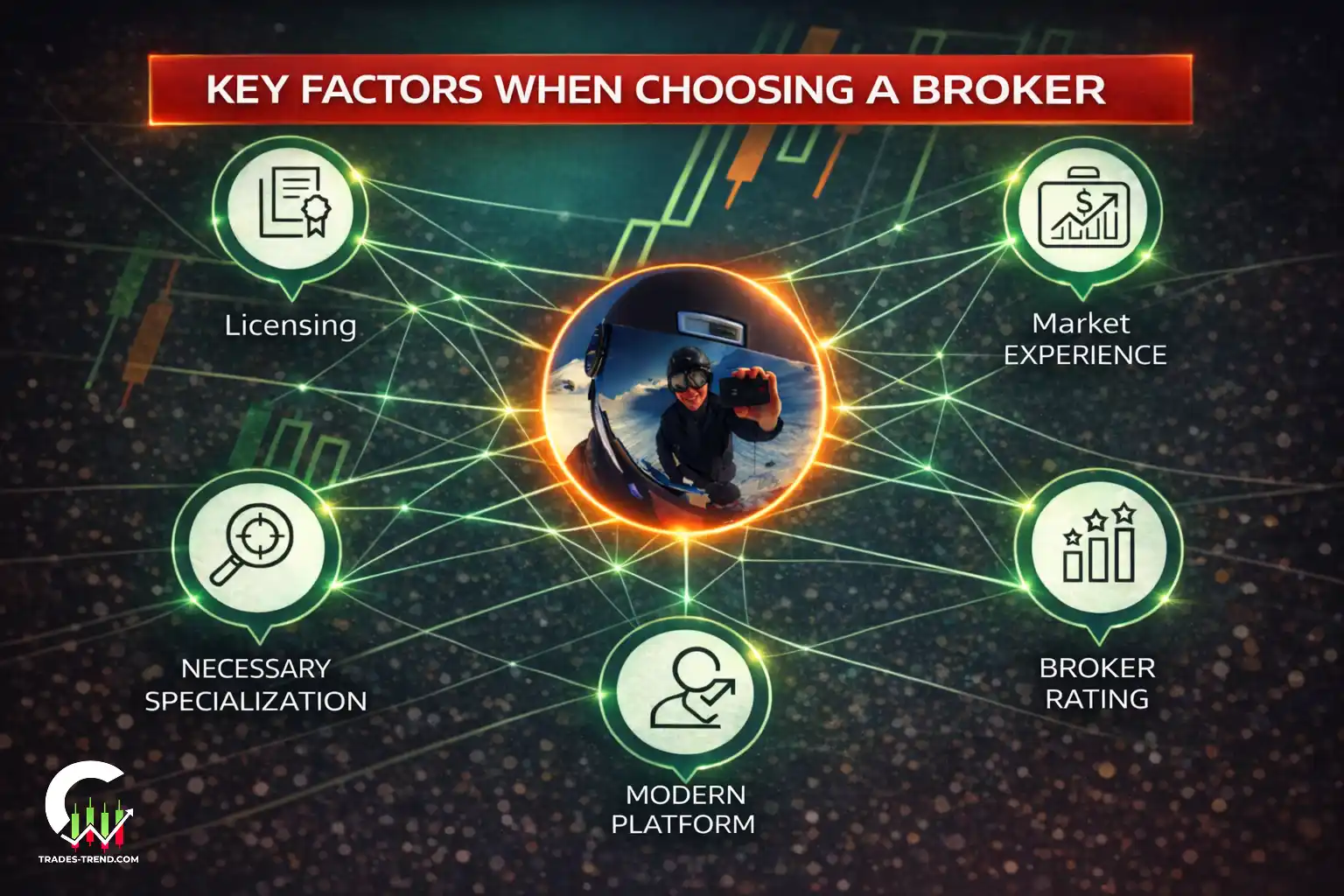
3) How to choose a broker: a beginner checklist
“Which broker should I choose?” isn’t about “the cheapest one” — it’s about safety and clear terms.
Broker checklist
- Regulation/registry — check your country/region (there’s no universal answer).
- Fees — not only per-trade, but also conversion, maintenance, hidden charges.
- Deposits/withdrawals — fees, timing, rules.
- Platform & reports — you should see trades, fees, and full history.
- Support — do they respond like humans, do they have a knowledge base?
- Red flags — pressure to “deposit more”, profit promises, “guaranteed wins”.
If you want a no-fluff checklist with real examples of red flags, see: “Choosing a broker: criteria and beginner mistakes”.
4) How much money do you need to start trading?
“How much do I need to start?” isn’t about a pretty number — it’s about whether you can follow rules.
- Your starting amount should allow a small risk per trade.
- You must be able to handle a losing streak without the urge to “win it back”.
- If your deposit is so small that you must risk big “to see any result”, emotions are almost guaranteed.
I break this down in detail here: what amount to start with and how to manage your capital, so you don’t burn money early on.
5) Demo account: how to practice so it actually works
A demo is not for “playing around”. It’s for:
- learning the platform and orders;
- building the habit of following risk rules;
- starting a trading journal without stress.
If your broker doesn’t have a demo
Use a simulator/paper trading, or practice “on history”: pick a setup, mark entry/stop/exit on the chart, and write it down like it’s a real trade. It’s worse than a demo, but far better than random live trading.
Practice routine (short and practical)
- 5–10 sessions of 20–30 minutes
- one instrument (an ETF or 1–2 stocks)
- one setup
- trade limit + loss limit
- after the session: 1 mistake, 1 takeaway, 1 rule for tomorrow
6) Basic order types: what a beginner needs (minimum)
To avoid turning trading into a lottery, start with three types:
- Limit — you set the price. Often a beginner’s best friend: fewer “accidental entries”.
- Market — executes immediately. During fast moves, you can get a nasty fill.
- Stop (stop logic) — you define where the idea is invalid and cap the loss.
7) Risk management: the basic system that keeps you alive
Strip it down and risk management is just limits that stop emotions from destroying your deposit.
Minimum risk-rule system
- Fixed risk per trade (small and consistent).
- Daily loss limit: hit it — stop.
- Daily trade limit: prevents “clicking” out of control.
- Stop after a losing streak: if you’re in a streak, pause/end the day.
- No “martingale” and no sizing up after a loss.
Mini practice: one scenario so you don’t get confused
- pick an ETF/stock → check spread/liquidity;
- use a limit entry (not “market”);
- decide in advance: where is the stop (where the idea breaks) and what’s the risk;
- after the trade, journal: why you entered, what followed the plan, what didn’t.
8) Beginner strategies: how to learn without chaos
A big beginner mistake is jumping between approaches. The start rule is simple:
1 market → 1 instrument → 1 setup → journal → 2 weeks of testing.
Examples of “starter” ideas (no promises, no “holy grails”):
- levels (bounce/breakout) + a clear stop;
- a trend filter + entry on a simple signal;
- one pattern you can mark the same way every time.
To sharpen chart reading (without guessing), start here: “Charts & indicators”.
9) Day trading for beginners: where most people break
Day trading looks exciting, but it often destroys discipline: faster pace, stronger emotions, more mistakes.
Don’t jump into day trading if:
- you don’t have a stable routine (sleep/stress/work);
- you tend to “win it back”;
- you don’t have a journal and stats;
- you can’t stick to limits.
10) Trading psychology: what blows accounts more often than strategies
Common issues:
- FOMO (you jump in because “it’s moving”);
- tilt (you try to recover losses);
- overtrading (too many trades);
- fear to close / fear to enter.
The simplest anti-chaos rule: decide in advance when you’re done trading (loss limit/trade limit/fatigue).
I cover this topic separately with real examples and rules that actually protect your deposit: Trading psychology: how not to blow your deposit.
11) Beginner mistakes (and what to do instead)
- Trading without risk limits → set a loss limit and a trade limit.
- “Bigger size to get faster results” → size kills discipline.
- Going live without practice → start with demo/simulator + journal.
- Jumping between strategies → commit to one setup for 14 days.
- Ignoring fees/spread/conversion → check costs before the trade.
- Chasing losses → stop after a streak and take a break.
- Trading tired → skip the day and protect your mindset.
- No journal → you won’t understand what to improve.
12) A learning plan: 7 / 14 / 30 days
| Time | Focus | What to do | “Ready to move on” criterion |
|---|---|---|---|
| 7 days | Mechanics & rules | 5–7 short demo sessions (20–30 min); one instrument; one setup; journal. | You respect loss/trade limits and understand orders (limit/market/stop). |
| 14 days | Discipline | Trade only one setup; after each session: 1 mistake, 1 takeaway, 1 rule for tomorrow. | 10+ journal entries; no chasing; you can stop after hitting a limit. |
| 30 days | Stats & real size | Collect trade statistics; track entry reasons/mistakes; go live with small size (strictly following the same rules). | Your process is repeatable: same rules, clear mistakes, stable discipline. |
Important warning
Trading involves a risk of capital loss. This material is educational and does not guarantee profit. Full disclaimer: trading risk disclosure.
From the stock market to binary options
For many people, the path looks like this: stocks/ETFs first (to understand market logic), and then other formats. Binary options often attract beginners because the mechanics are simple (“up/down” and fixed risk), but discipline is critical there.
I run trading sessions for readers and subscribers — publicly, without paid “VIP clubs”.
Join my Telegram channel.
Why do I use Binarium?
When it comes to practice and a simple start, I highlight Binarium:
- Clear interface;
- Fast platform response;
- Convenient funding options.
The key is not to treat it like a casino. A solid approach means you have an entry system and statistics. Binarium is simply a working tool.
Use promo code TREND when registering on Binarium — it doubles your first deposit (+100%).
Final recap
Trading isn’t about “quick money”. It’s about consistent steps: learning → practice → risk rules → journal → discipline.
If you do the right steps and protect your deposit, results become a matter of time and practice.
Ready to start?
I recommend starting on Binarium. With promo code TREND you’ll get a +100% deposit bonus.