Intraday trading on binary options: strategies and rules for beginners (2026)

Risk warning: trading binary options involves a high level of risk. This material is for educational purposes only and is not individual investment advice.
“I want to earn, but I’m afraid to blow my deposit” — that’s a normal starting thought. Many beginners already “played” with turbo trades, got a couple of quick wins, and then gave everything back to the market in one evening. In my experience, the reason is almost always the same: not the strategy, but the lack of a system — the chain “analysis → entry → risk limit → pause”.
At Trades-Trend we don’t sell “get-rich-quick” fantasies. We teach you to read the chart and stay disciplined: binary options are not a casino, they’re math + rules. Below is a clear step-by-step guide that helps beginners move from chaos to structured intraday trading. And to test these strategies in practice, you can register on Binarium with promo code TREND and get a +100% deposit bonus.
What intraday trading (day trading) means in options
In classic markets, day trading means trades opened and closed within the same day (before night) so you don’t carry risk overnight. In binary options, 99% of trades are intraday by nature: turbo (30–60 sec), 1–5 minutes, 15 minutes, 1 hour.
Pros of intraday trading in binary options:
- Fast outcome — you see the result right away.
- Fixed risk — you know in advance how much you can lose (the stake).
- Simple mechanics — “higher/lower” at the moment of expiry.
Cons:
- Emotional pressure — frequent decisions can trigger tilt.
- Overtrading temptation — “one more trade and I’ll get it back for sure”.
- Timing mistakes — wrong expiration can ruin even a good analysis.
| Parameter | Binary options | Forex |
|---|---|---|
| Entry complexity | Lower (simple “higher/lower” mechanics) | Higher (lots, pips, swaps, spreads) |
| Profit calculation | Fixed payout %, known in advance | Depends on price move, spread, fees |
| Stop-losses | Not required (risk = stake) | Mandatory (otherwise risk is uncontrolled) |
| Where beginners fail most often | Expiration + tilt + martingale | Leverage + no stops |
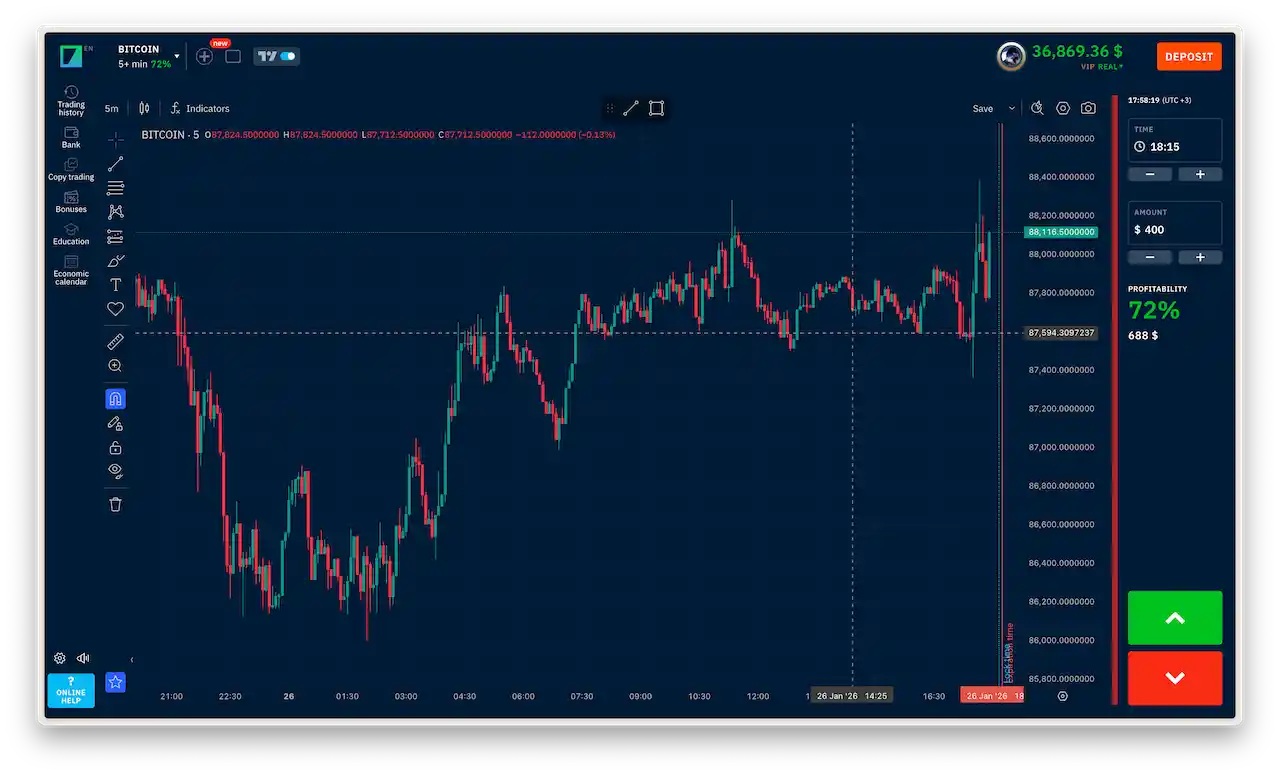
Preparation: the foundation you can’t skip
1) Choosing an asset: why EUR/USD is better than “crypto on weekends”
Beginners need an asset that moves more predictably and has decent liquidity. For starters, majors usually work best: EUR/USD, GBP/USD, USD/JPY. They’re active during market hours and are less “choppy” for no reason.
Weekend crypto often delivers sharp impulses and false moves on thin liquidity. If you still don’t respect risk limits, it’s a fast track to tilt.
2) Trading sessions: when the market is “alive” and when it “sleeps”
Intraday trading loves periods with volume and movement. Usually that’s session overlaps and the first hours after the open.
| Session | What to trade | Most active (rough) | Comment |
|---|---|---|---|
| London | EUR/USD, GBP/USD | morning–afternoon (Europe) | Often the best trend moves of the day |
| New York | EUR/USD, USD/JPY | afternoon–evening (Europe) | Strong impulses around US news |
| London–New York overlap | Majors | a few overlap hours | Max activity—but also max “noise” |
Note: exact hours depend on seasonal time (CET/CEST). The idea is simple: trade when the market moves, not when it chops in a tight range.
3) The key beginner connection: analysis timeframe ↔ expiration time
The most common mistake: you analyze a trend on H1, then place a 30-second trade. Or you see a signal on M1 and set expiry to 2 hours. These are different movement scales. To protect your stats, follow a simple rule:
Expiration ≈ 3–5 candles of your timeframe. That gives the idea enough time to play out.
| Chart timeframe (TF) | Expiration (trade time) | Trading style |
|---|---|---|
| M1 (1 minute) | 3–5 minutes | Scalping (risky!) |
| M5 (5 minutes) | 15–30 minutes | Moderate (recommended) |
| M15 (15 minutes) | 45–60 minutes | Calm / trend-based |
Top 3 intraday strategies (with examples)
Below are three approaches a beginner can learn. Important: don’t mix everything at once. Pick one strategy and build solid stats on demo (or micro-stakes).
Strategy 1: Trend following
Idea: don’t try to “catch reversals.” It’s easier to make money when you’re aligned with the main move. Old but true: Trend is your friend.
Chart setup (beginner-friendly):
- Timeframe: M5 (great for starting)
- Indicator: Moving Average (MA 50) or EMA 50
- Expiration: 15–30 minutes
Step-by-step:
- Define the trend: price above MA 50 and MA slopes up → uptrend. Below and down → downtrend.
- Wait for a pullback: don’t buy the top. Let price pull back to the MA / a local level.
- Enter after confirmation: wait for the candle close back in trend direction (e.g., a bullish candle after the pullback).
- Trade: UP in an uptrend / DOWN in a downtrend.
- Filter: if the market is chopping sideways (flat) — skip.
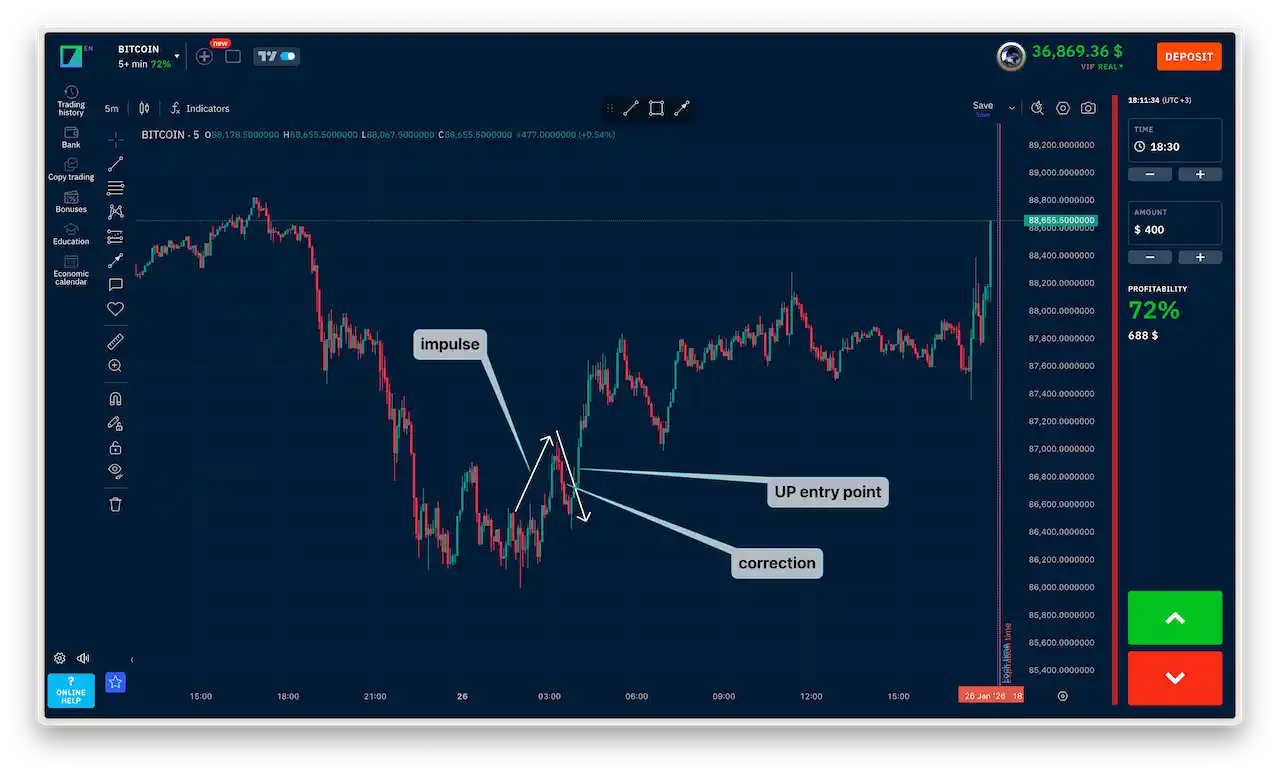
Practical tip: beginners usually lose not because the trend “broke,” but because they enter without a pullback and eat the correction. Let price pull back—then trade. More about indicators and chart settings is covered in a separate article.
Besides trend following, it’s useful to learn classic reversal patterns. One of the most reliable is “head and shoulders”. It helps you spot when the trend is running out of steam and avoid fighting the market.
Strategy 2: Sentiment check via Investing.com (technical summary)
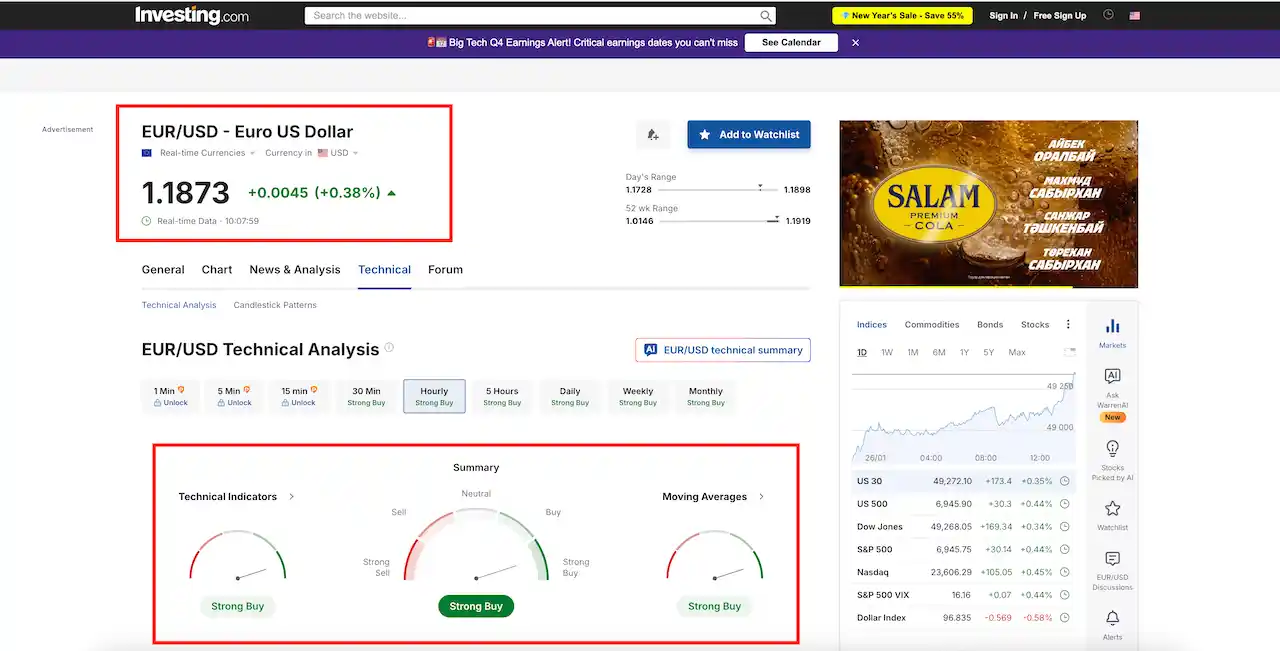
Sometimes beginners lack context: what the market “thinks” on higher timeframes. A convenient tool is the technical summary on Investing for an asset—for example, EUR/USD: EUR/USD technical analysis on Investing.
What you get: a snapshot from indicators (MAs, oscillators) and an overall conclusion like “Strong Buy / Buy / Neutral / Sell” for the selected timeframe. Treat it as a rough “temperature gauge” (fear/greed)—but not a one-click signal.
How to use it intraday (logic example):
- Open Investing → choose the asset (e.g., EUR/USD) and timeframe H1.
- If H1 shows “Strong Buy”, your job is to look for entries in the buy direction—not to short “because it’s high.”
- Then open your broker platform and switch to M1–M5 to time the entry more precisely.
- Wait for a micro pullback / local level and enter with the higher-TF trend.
Important (so you don’t lose money on “smart websites”):
- If major news is happening right now, the summary can get distorted by impulsive moves. Check the economic calendar on Investing or follow major media (e.g., Bloomberg).
- Don’t use a 30-second expiry if your context is H1. For M1 entries, use 3–5 minutes; for M5, use 15–30 minutes.
- If it says “Strong Buy” but your chart is flat—better not to force a trade.
Strategy 3: Follow “smart money” in crypto (via alerts)
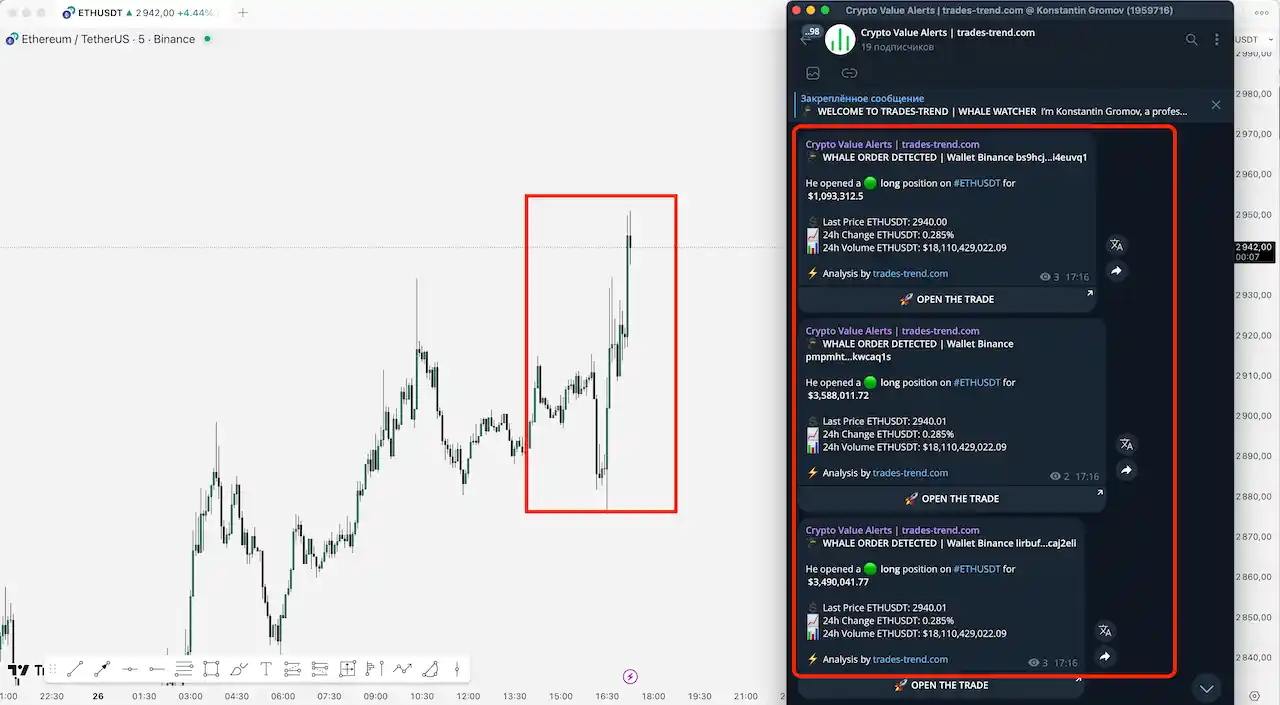
If you trade crypto assets with a broker, it helps to see where large flow is happening in real time: big trades and liquidations often create short-term impulses. For this I use the Telegram bot t.me/crypto_trades_trend (Crypto Value Alerts): it tracks trades from $1M on top-10 assets and shows liquidations.
How to use it in binary options (no magic):
- A series of big buys (several $1–2M+ long orders in a row) often means short-term upward pressure.
- Mass liquidations can accelerate the move: after liquidations, price sometimes “pushes through” and then pulls back.
- Your goal isn’t to predict the top—it’s to enter after the impulse and capture a small slice of the move.
| Alert signal | What it may mean | What a beginner should do |
|---|---|---|
| Several big long trades in a row | Buyers are pushing price up | Look for an UP entry on M1–M5 after a micro pullback |
| Several big short trades in a row | Sellers are pushing price down | Look for a DOWN entry on M1–M5 after a pullback |
| Liquidation spike | Acceleration, a “flush” move | Don’t catch a falling knife. Wait for stabilization and candle confirmation |
Quick algorithm:
- Get an alert about a series of large trades (long/short).
- Open the asset chart → confirm it’s a real impulse, not random noise.
- Wait for a micro pullback and candle confirmation.
- Expiration: for M1 use 3–5 minutes, for M5 use 15 minutes.
Risk management: why beginners blow accounts
The hard truth: without money management, any strategy eventually takes you to zero. In binary options it’s especially dangerous because losses feel “small and fast” — and your hand automatically reaches for revenge trading. To avoid that, follow risk management rules.
- Risk no more than 1–3% of your deposit per trade.
- No martingale (doubling after a loss): it destroys accounts during losing streaks.
- Daily loss limit: for example, down 10% → close the platform until tomorrow.
Example: your deposit is $100.
| Stake size | How many losses until zero (rough) | What it means |
|---|---|---|
| $2 (2%) | about 50 | You have room to learn and make mistakes |
| $10 (10%) | about 10 | Any bad streak breaks your stats |
| $20 (20%) | about 5 | A couple of emotional trades—and you’re done |
Many beginners dream of “growing” a small deposit into a big one. It’s possible, but it requires a clear system—not random bets. If you want to try an aggressive approach without blowing up, read the guide how to grow a binary options deposit with safeguards.
Why martingale is poison for beginners: the market can produce a streak of 6–10 losing trades even with a working strategy (flat, news, noise). Doubling grows like a snowball, and you quickly reach a stake your deposit can’t handle.
If you want to test strategies in comfortable conditions — open an account on Binarium and use promo code TREND to get a +100% bonus.
Psychology and discipline
Tilt is the “I’ll win it back now” state—when you trade from pain instead of a system. In my experience, tilt starts after two things: a losing streak and the urge to get your money back immediately. The cure is boring, but it works: limits + a journal.
Another trap beginners fall into is FOMO (fear of missing out). You see price “flying” and you enter without analysis just to not be left out. The result is predictable: entry at the top, loss, tilt. I break down how FOMO kills a deposit and what to do about it in a separate article.
Trader journal template (Google Sheets / Excel / Notion):
| Time | Asset | Direction | Entry reason | Expiration | Result | Emotions |
|---|---|---|---|---|---|---|
| 10:15 | EUR/USD | UP | Uptrend, pullback to MA50, candle confirmed | 20 min | + | Calm |
| 11:05 | EUR/USD | DOWN | Entered without a pullback (mistake) | 5 min | - | Rushed |
Checklist: 5 steps before opening a trade
- Checked the news? (economic calendar, key events)
- Defined the trend? (on your working TF)
- Waited for candle close? (don’t enter mid-impulse)
- Verified stake size? (1–3% of deposit)
- Enter! (and don’t touch buttons until the outcome)
FAQ
What’s the minimum amount that makes sense to start intraday trading with?
You can start learning with a demo account (free). For live trading, a comfortable starting point is $50–100 so you can follow risk management (trades of $1–2). With a $10 deposit, consistent trading is almost impossible because proper risk management doesn’t “fit.” If you’re not sure where to start, I have a step-by-step beginner guide.
How much time per day should I spend watching charts?
Ideally 2–3 hours. It’s better to trade less but with higher quality—during active market phases (for example, the London or New York open). Sitting for 10 hours hurts focus and leads to overtrading.
Can I trust signals from Telegram channels?
Be skeptical. Signals are a hint, but you should always make the final decision yourself. If you copy blindly, you won’t learn how the market works—and sooner or later you’ll blow your deposit.
Do I need to download a terminal, or can I trade in the browser?
Most brokers offer web platforms in the browser. For deeper analysis, it’s convenient to use TradingView and place the trade at your broker.
How is intraday trading different from long-term trading?
With intraday trading you lock in the result the same day and don’t hold positions overnight, so there’s less risk from “overnight surprises.” It’s faster, but it requires attention and discipline.
Is it realistic to live off trading income?
Yes, but not immediately. For the first 6–12 months, the goal is not to lose and to learn how to produce a small, steady profit. Once you’re stable, you can scale gradually.
Bottom line: choose one asset (e.g., EUR/USD), one timeframe (M5), one strategy (trend following), respect risk limits, and keep a journal. This won’t “guarantee millions,” but it massively improves your odds of moving from randomness to a system.
Risk warning: trading binary options involves a high level of risk. This material is for educational purposes only and is not individual investment advice.
Ready to apply this in practice?
Fund your Binarium account and use promo code TREND to get a +100% bonus and test the strategy.