How to Ramp Up a Binary Options Deposit Without Blowing Up: A Safety-First Strategy

A deposit ramp-up isn’t a “secret button” — it’s a high-risk mode. It doesn’t break the market, it breaks discipline: after a loss you start chasing, position size creeps up, extra trades appear — and the balance can drop to zero fast.
Below is a practical framework to make a ramp-up a system: with stops, limits, and clear “when to quit” rules. And if you trade on Binarium, start with minimal size and test the approach on demo/small stakes — when you register, use promo code TREND. Start trading on Binarium
Disclaimer: this is educational content, not financial advice. Trading financial markets involves high risk. Details: risk disclosure
Table of contents
- What a ramp-up is and why people blow up
- Who it’s for — and who should avoid it
- Mistake #1: revenge trading (and how to cut it off)
- The foundation: limits and stop-trading rules
- “Ladder + lock-in” (no martingale)
- Daily plan: before / during / after
- Trade journal: template
- 3 blow-up scenarios — and how to stop them
- Helpful materials
- FAQ
1) What a ramp-up is and why people blow up
A ramp-up is an attempt to grow a balance fast, usually by:
- taking higher risk per trade,
- increasing the number of trades,
- pushing a “ladder” (after a win you want to press harder),
- and (most dangerous) using martingale after a loss.
Why accounts get wiped:
- losing streaks happen to everyone (it’s a normal part of statistics),
- beginners treat a loss as a “mistake that must be fixed immediately,”
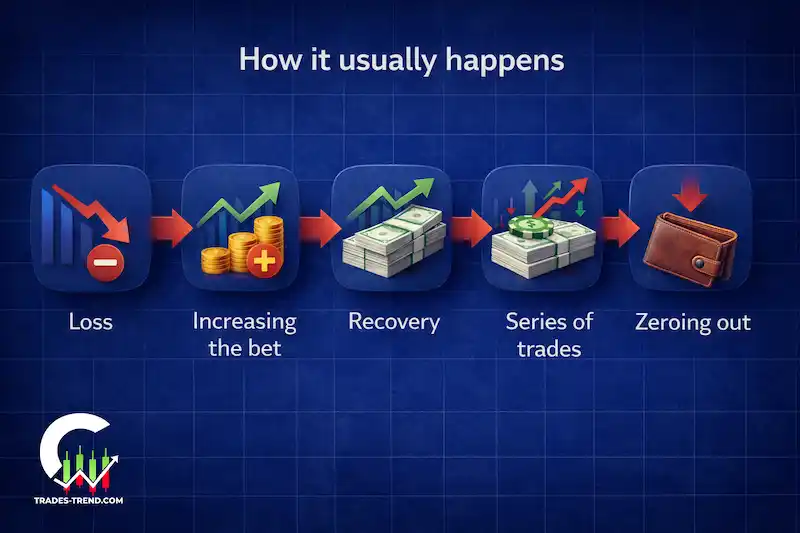
- and the script starts: loss → bigger size → another trade → bigger size → wipeout.
2) Who it’s for — and who should avoid it
It fits if you:
- can keep limits without “just one more,”
- can pause after a losing streak,
- are willing to journal (even 1 minute after the session).
Avoid it if you:
- often try to win it back,
- like to jump size “because I’m sure,”
- trade when tired/irritated/stressed.
If you’re at the start — go through the beginner’s “where to start” base first (it genuinely helps bring order to your thinking).
3) Mistake #1: revenge trading (and why it kills the deposit)
Revenge trading is when you enter not because you have a clear signal, but because “I need to get my loss back.”
Signs you’re chasing:
- you enter “by feel,”
- you speed up and take trades faster,
- you want to increase size “to get it back quicker,”
- you ignore limits.
Rule: the moment you feel “I have to get it back right now” — that’s already a stop signal. Not “I should focus,” but “I should stop.”
4) The foundation: limits and stop-trading rules
Here’s the key point: you can trade patterns or indicators — but without safety rules, the ending is usually the same.
At least 4 limits
- Fixed stake (or fixed risk) per trade.
- Don’t change it during the day “based on mood.”
- Daily loss limit: once hit — trading is over.
- Max trades per day so you don’t slide into chaos.
- Pause after a losing streak: 2–3 losses in a row → pause. No debate.
If you want it deeper and more systematic, I recommend the risk-management basics.
| Mistake | Why it’s dangerous | What to do |
|---|---|---|
| Revenge trading after a loss | turns 1 loss into a chain | stop/pause + close the terminal |
| Sudden size increase | one bad stretch = wipeout | size is fixed for the session |
| Too many trades in a row | errors and noise | trade limit + pauses |
| Trading while tired | impulse mistakes | trade only when you’re “in shape” |
| You broke the rules | you reinforce a bad habit | “broke it → stop for today” |

Checklist: “STOP today if…”
- you hit your daily loss limit;
- 2–3 losses in a row and you feel tilted;
- you want to get it back right now;
- you already violated your entry checklist;
- you’re trading more often than planned;
- you feel anger/euphoria/gambling mode;
- you can’t explain the entry in one sentence;
- you’re tired / sleep-deprived;
- you want to sharply increase size.
There are days when it’s better to pause. People who trade with me LIVE might have noticed: if the market is “feverish” or the trend isn’t clean — I say it directly, we pause and continue when conditions get clearer.
Example of how I trade together with readers: YouTube (LIVE trading example)
If you want to trade with me — message me on Telegram. I’ll add you to the group — it’s free.
And yes: if you choose Binarium as your practice venue, don’t let a bonus become a reason to “push size.” Promo code TREND is just a start option — not a reason to break risk rules. Go to Binarium
5) A ramp-up without martingale: “Ladder + lock-in”
I’m intentionally not giving any doubling/martingale scheme. For beginners, it’s the shortest road to a blow-up.
If the goal is to ramp up and not blow up, the strategy should look like this:
Strategy rules
- Stake is fixed (or within a narrow range).
- Only take trades based on a signal (not “I need to recover”).
- After a losing streak — pause.
- After a winning streak — don’t speed up (euphoria also kills).
- Partial lock-in: hit your session target → move part to “reserve” or simply end the day.
- Broke a rule → stop for today.
The idea: you ramp up discipline and statistics — not risk. Money is a consequence.
6) Daily plan: before / during / after
Before trading: entry checklist (no checklist — no trade)
- Is there a clear signal in my system?
- Can I explain the entry in one sentence?
- Am I still within my daily limits?
- Is my stake fixed for today?
- Am I not chasing?
- Am I not tired / angry?
- Does the market look clean (not a choppy saw)?
- Am I ready to skip if conditions aren’t met?
Any “no” → skip.
During trading: one hard rule
Don’t change size and rules on emotions.
If you want to increase stake “because I’m sure” — you’re already out of the strategy.
After trading: mini review (1–2 minutes)
Write in your journal:
- why you entered,
- whether there was a mistake / rule break,
- what emotion you felt,
- what to improve tomorrow.
7) Trade journal: template (copy & use)
Below is a simple template (notes/spreadsheet works). The key: one sentence “why I entered” and a checkbox if you broke a rule.
| Date | Asset | Why I entered (1 sentence) | Stake/risk | Streak (W/L) | Rule broken? | Emotion | Result/notes |
|---|---|---|---|---|---|---|---|
| 2026-01-04 10:15 | EUR/USD | Level break + retest | 10$ | W-W | No | calm | All per plan, checklist entry. |
| 2026-01-04 10:42 | BTC | FVG + candle confirmation | 10$ | W-W-W | No | confident | Good. Don’t speed up after wins. |
| 2026-01-04 11:05 | US500 | Head and shoulders: neckline break | 10$ | W-W-W-L | No | calm | Loss is normal. Don’t change size. |
| 2026-01-04 11:12 | US500 | “I want it back” (not a signal) | 20$ | W-W-L-L | Yes | anger | Chasing. Stop trading, 1-hour pause. |
| 2026-01-04 12:30 | Gold | Bounce from level | 10$ | L-L | No | doubt | Entered per plan, but doubted — reduce noise/slack. |
| 2026-01-04 13:10 | EUR/GBP | Break + confirmation | 10$ | L-W | No | calm | Back to plan. The key is keeping limits. |
8) 3 blow-up scenarios — and how to stop them
Scenario 1: losing streak → chasing → wipeout
How to stop it: 2–3 losses in a row = pause, and if you feel like “I need it back” — stop for the day.
Scenario 2: winning streak → euphoria → risk inflation → wipeout
How to stop it: trade limit + fixed stake. Don’t speed up on a win streak.
Scenario 3: fatigue/stress → chaos → wipeout
How to stop it: trade only in a normal state + rule “no energy — no trades.”
9) Helpful materials
A ramp-up is the tip of the iceberg. To stand on solid ground, I recommend these core guides that professional trading relies on:
- Beginner base: how to start trading without rose-colored glasses
- Money management: calculating risk and percentages per trade
- Discipline psychology: how to stop tilting and blowing up
- How much to start with on Binarium to trade comfortably
- “Head and Shoulders” strategy: a systematic entry example
- Options scalping: how to take fast trades with a clear head
- Automation and bots: how to remove the human factor
- Guide to choosing and connecting a trading assistant
10) FAQ
1) Can you ramp up a deposit and never blow up at all?
Completely “risk-free” — no. But you can significantly reduce blow-up odds with limits, stop-trading rules, and a strict ban on revenge trading.
2) Why do most people blow up specifically during a ramp-up?
Because a ramp-up accelerates emotions: after a loss you start chasing, and after a win — euphoria. In both cases rules get violated.
3) What matters more: entries or risk management?
For “not blowing up”, risk management matters more. Even a good strategy dies if you size up and break limits.
4) What should you do after 2–3 losses in a row?
Pause. Review. If you feel like “I need to get it back” — stop for the day.
5) Why shouldn’t you martingale after a loss?
Because you start ramping risk instead of improving entry quality. One bad stretch turns into a wipeout.
6) Do you need a journal?
Yes. Otherwise you won’t understand where you’re really “blowing up”: in the strategy or in discipline.
7) When should you lock in profit during a ramp-up?
When you hit your session/day plan. “Not blowing up” means knowing when to stop and not giving profits back.
Ready to put this into practice?
Fund your Binarium account and use promo code TREND to get a +100% bonus and test the strategy.