Binary Options in Simple Terms: Types, Examples, and the Difference from Futures

Promo code: TREND (+100% on your first deposit)
Important: this material is for educational purposes. Before putting anything into practice, read the disclaimer.
Binary options only look simple at first glance. Before doing anything practical, it is important to understand how the trade works, what types of setups exist, and how a binary option differs from a standard option and a futures contract. This guide keeps it clear and practical: how it works, where beginners usually make mistakes, and how to approach trading in a calmer and safer way.
If you came here through searches like “types of binary options,” “binary market,” or “how an option differs from a futures contract,” the goal is usually the same: to build a solid basic picture fast. For the broader foundation, it also helps to keep this guide nearby: what trading is and how to start as a beginner.
Quick answer: what binary options are in simple terms
A binary option is a trade with a predefined scenario and a fixed outcome. The trader chooses a condition, for example “the price will be higher” or “the price will be lower” at a certain time, and when expiration arrives, the platform checks the result.
The strength of this format is its simple logic: before opening the trade, you already see the condition, the time, and the size of the risk. But a simple interface does not remove the need for discipline. Without understanding price movement, even the clearest setup quickly turns into guessing.
What options are in general: the foundation before binary options
To avoid mixing up the terminology, it helps to separate standard options from binary ones. A standard option is a contract that gives the right to buy or sell an underlying asset at a predefined price within a set time period, but does not force you to do so.
That is where familiar terms like call and put, European and American style, and cash-settled or physically settled contracts come from. This is already part of the classic exchange toolkit. If you want a better understanding of how market infrastructure works, it is worth reading the guide about the broker and the role of an intermediary in trading.
How binary options work: trade mechanics
No matter which platform you use, the core logic is the same: asset → condition → expiration → stake → result. You choose the instrument, define the scenario, set the expiration time, and decide how much you are willing to risk.
Step by step (5 steps)
- Choose an asset: a currency pair, index, stock, cryptocurrency, or another available instrument.
- Choose the trade condition: higher/lower, touch of a level, or staying inside a range.
- Set the expiration — the moment when the result will be fixed.
- Define the stake — the amount you are ready to risk on this trade.
- Wait for expiration: the system will compare the final price with your condition and show the outcome.
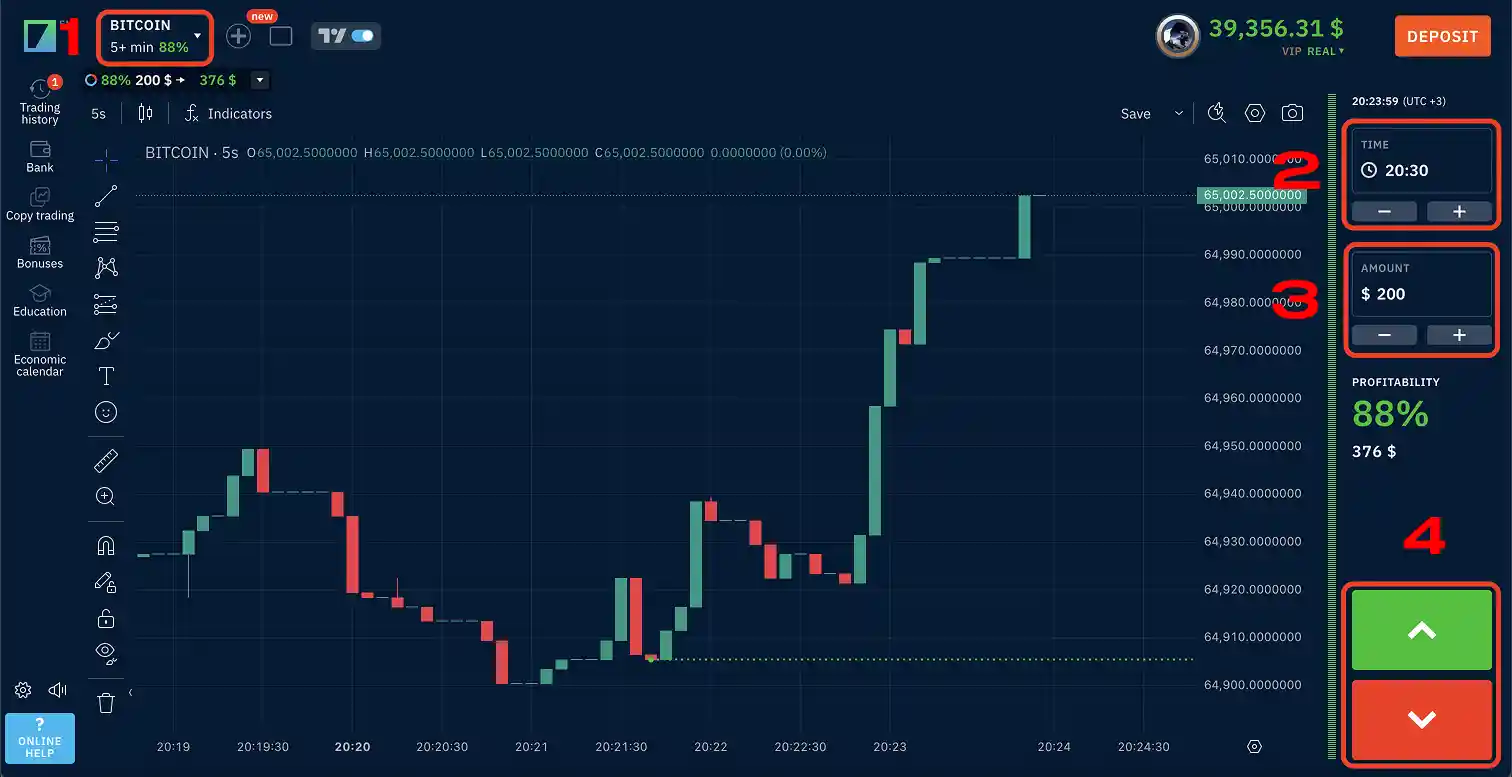
Once time runs out, only one question remains: was the condition met or not? That is exactly why binary options are described as a fixed-outcome format.
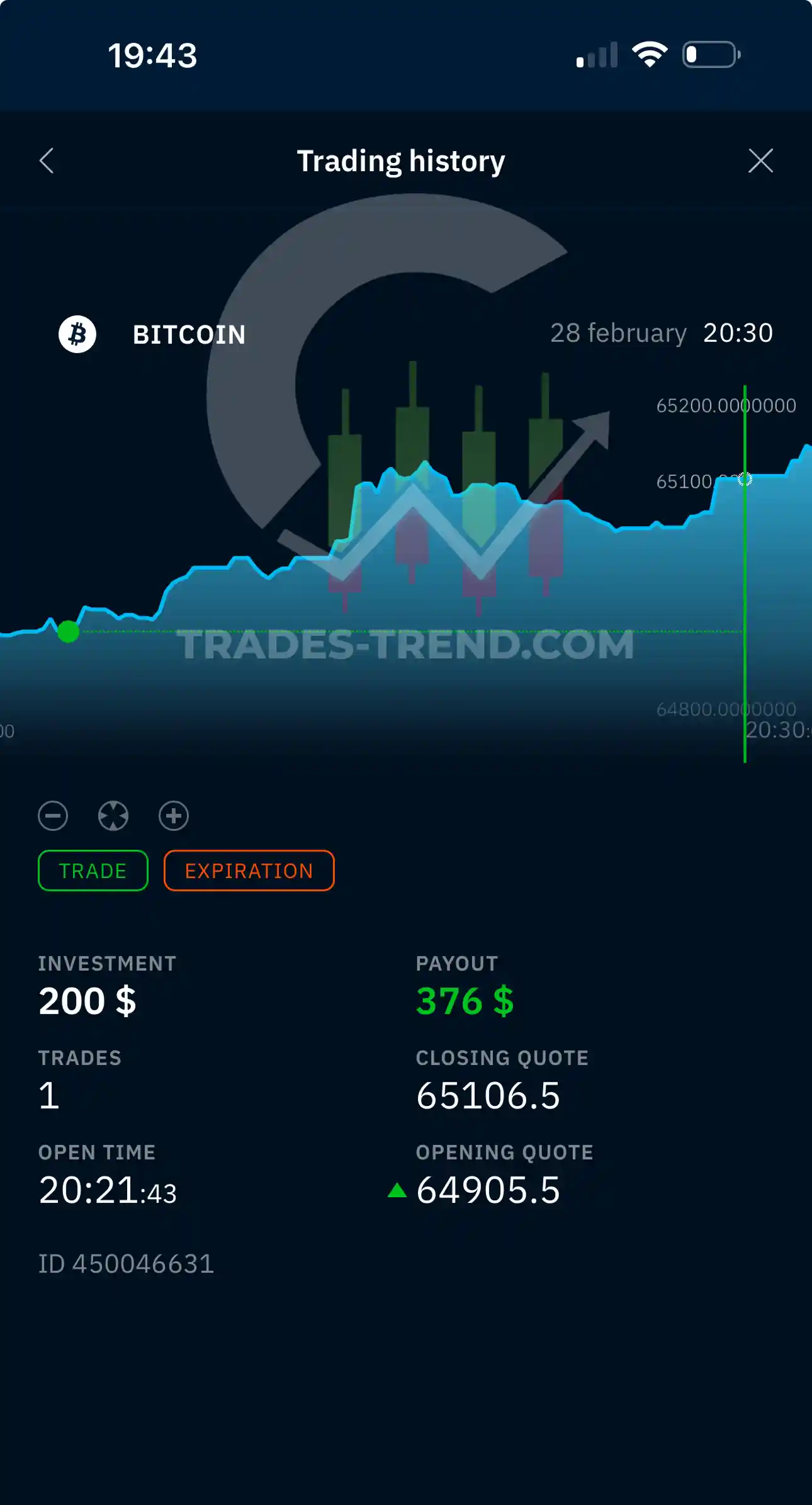
If you want to see this logic inside a real terminal, you can open Binarium. For your first deposit, the promo code TREND gives you a +100% bonus — but it only makes sense to move into practice after you understand the trade mechanics.
Terms you need to understand
- Expiration — the moment when the trade outcome is determined.
- Payout — the potential return on a successful trade. The percentage depends on the asset, the timing, and the platform conditions.
- Fixed outcome — the logic of “condition met / condition not met” at expiration.
Types of binary options
The main difference between binary option types is not the platform name, but the winning condition. Beginners usually start with the basic “higher/lower” setup and only later move on to more complex scenarios like touching a level or trading inside a range.
One more important point: “turbo” is usually not a separate option type, but a format with a very short expiration. The less time a trade has, the stronger the market noise and the higher the chance of making a mistake.
| Type | Winning condition | When it is used | Typical beginner mistake |
|---|---|---|---|
| Up/Down (Call/Put) | At expiration, price is above or below the entry point | The basic setup for getting started | Entering with no reason, just guessing |
| Touch / No Touch | Price touches a level or does not touch it before expiration | When there is a clear level or momentum | Betting on a random level |
| In/Out (range) | Price stays inside a range or breaks out of it | When the market is calm and moving sideways | Ignoring volatility and news |
| Turbo | The same condition, but on a very short time frame | Use carefully, and definitely not as a starting point | Switching to turbo after a losing streak |
A comparison of the main binary option types and typical beginner mistakes.
2 mini examples
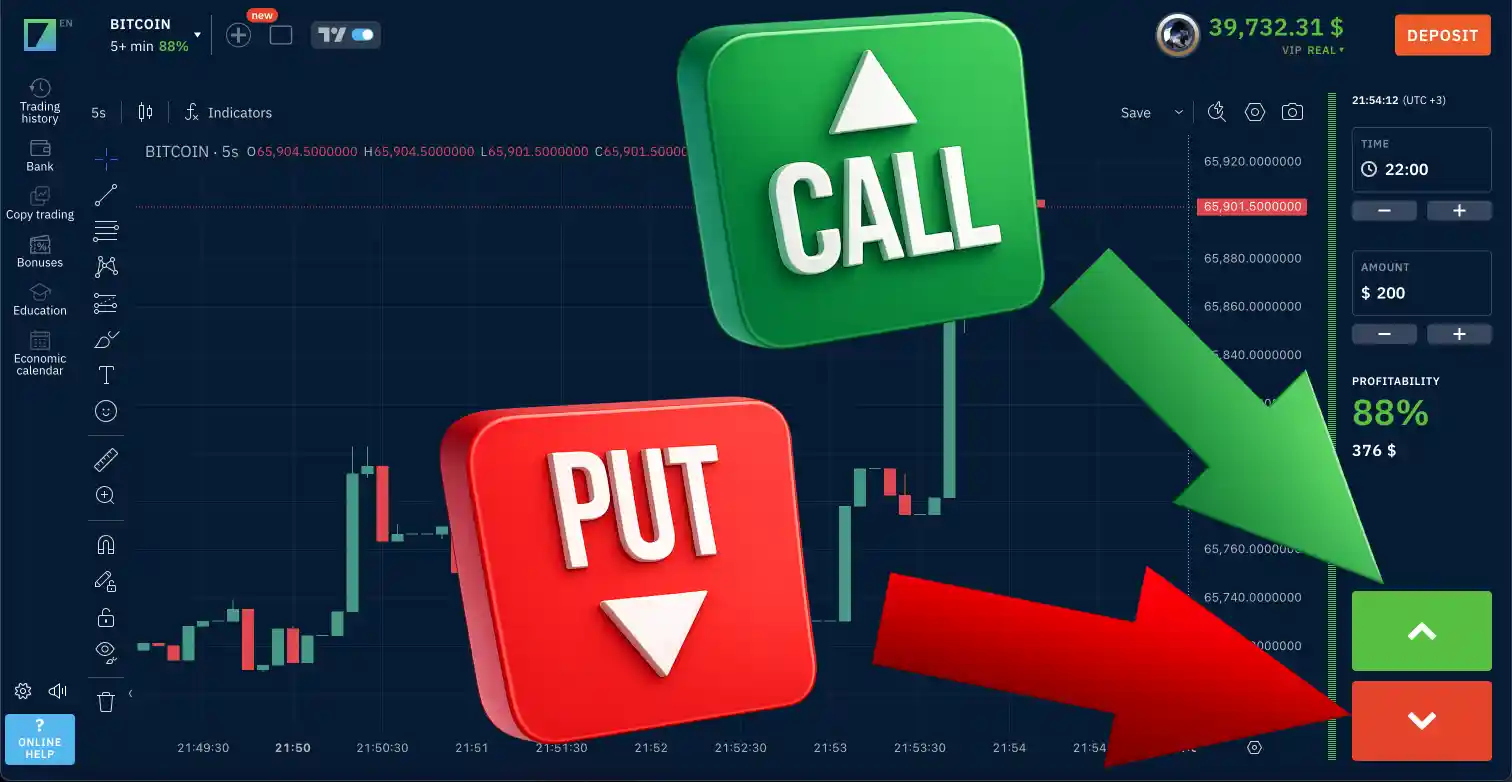
- Call/Put: you assume that in 5 minutes the price will be higher or lower than the current level.
- In/Out: you bet on whether the price will stay inside a range by expiration or move outside it.
Crypto binary options — how does that work?
When people say “binary options on cryptocurrency,” they usually do not mean a separate instrument. They simply mean a cryptocurrency used as the underlying asset. The trade mechanics stay the same: condition, expiration, stake, and the final result at a predefined moment.
What changes is not the option logic, but the behavior of the asset itself: the crypto market is often more volatile than many currency pairs. To better understand the difference between crypto, forex, stocks, and indices, it helps to keep this comparison of the main markets for beginners nearby.
“Binary exchange,” “binary market,” and “binary trading on an exchange” — what people usually mean
This is where wording often gets mixed up. In everyday language, people sometimes call the platform itself a “binary exchange” simply because it offers binary options. But that does not mean it is a brand-new standalone exchange with its own separate market model.
- Binary options — a fixed-outcome trade format.
- Binary exchange — a casual name for the platform or website where those trades are available.
- Binary trading on an exchange — a phrase that existed historically, but in ordinary search queries usually refers to an online platform.
If you want to separate the concepts of “exchange,” “platform,” and “intermediary” more clearly, go back to the guide on market infrastructure and the broker’s role.
Option vs futures: the difference in simple terms
The shortest formula is this: an option is a right, while a futures contract is an obligation. A binary option works differently again: there is no purchase of the asset in the classical sense — there is a bet on whether a condition will be met at a specific moment.
| Instrument | What you are buying | Obligations | Trade outcome | Core idea |
|---|---|---|---|---|
| Standard option | The right to buy or sell an asset | The buyer is not obliged to execute the contract | Depends on the asset price and the contract terms | A right, not an obligation |
| Futures | A contract to buy or sell an asset | The obligation is much stricter | Depends on the movement of the contract price | An obligation |
| Binary option | A bet on whether a condition will be met at a certain time | A fixed trade condition | A fixed outcome | Yes/no at expiration |
A quick comparison of a standard option, a futures contract, and a binary option.
If you want to look at an alternative to binary options and understand the logic of more classical markets, start with the beginner’s guide to trading stocks.
When binary options appeared
As a separate exchange product, binary options began to take shape in the late 2000s. The year 2008 is often mentioned as a key point when this format became more visible in terms of launches and regulatory treatment on a number of venues.
“Binary auctions,” “binary auction,” and “binary bidding” — what that means
Usually, this is not a separate financial term but simply wording confusion. In most cases, people mean binary options, while using the word “auction” as a casual substitute for “trading.”
That is why context matters here: if you see those words in an article or a search query, they almost always refer to binary trading rather than to an actual auction mechanism.
What binary signals are
Binary signals are trade prompts: direction, asset, and sometimes expiration time. But a signal by itself does not solve the discipline problem. Without risk limits and an understanding of the context, it easily becomes just another form of guessing.
To keep signals from turning into chaos, three things are usually needed:
- a risk limit for each trade;
- a trade journal;
- an understanding of why the entry is being considered at all.
Every day, I run two trading sessions — one during the day and one in the evening — where I show market analysis and real entry points. If you want to watch live trading and review trades together with the community, message me on Telegram.
Risks and honest limitations
This part should be completely straightforward: binary options are not about “easy money.” They are about working with fixed risk. If the forecast is wrong, the stake is often lost in full.
- short expirations amplify market noise;
- chasing losses and martingale strategies inflate risk very quickly;
- without money management, trading turns into gambling;
- a simple interface does not replace market analysis.
How a beginner can start more safely
- First, understand the basic mechanics: setup types, expiration, and the logic of the fixed outcome.
- Understand how a binary trade differs from a standard option and a futures contract.
- Compare markets and instruments so you do not confuse crypto, forex, indices, and stocks.
- Practice on demo or with minimal size.
- Keep a trade journal and do not drift into “turbo just for the adrenaline.”
If you see Binarium as a practical example of a platform, first study the interface, the entry rules, and the terminal logic. Then, when moving to a real account, you can use the promo code TREND on your first deposit — the +100% bonus only helps when you already have a basic plan instead of an urge to trade on emotion.
FAQ
What are binary options in simple terms?
It is a trade built around a “met / not met” condition at expiration. The result is fixed at a predefined time.
How do binary options work?
You choose an asset, a trade scenario, an expiration time, and the amount you are willing to risk. At expiration, the platform checks the condition and shows the result.
What types of binary options are there?
The main setups are Call/Put, Touch/No Touch, and In/Out. “Turbo” is more often a short expiration format than a separate instrument type.
What are options if not binary options?
A standard option is a contract that gives the right to buy or sell an asset within a set time frame without a strict obligation to exercise it.
How is an option different from a futures contract?
An option gives a right, while a futures contract is built around an obligation. A binary option works differently: the outcome depends on whether a condition is met at expiration.
Is a binary platform really an exchange?
Usually not. Most often, people use that phrase to mean a platform or website where binary options are available.
What are binary auctions / a binary auction?
Usually this is just wording confusion: in most cases the person actually means binary options.
What are binary signals?
These are trade prompts: direction, asset, and sometimes timing. But they do not replace risk management or personal discipline.
Conclusion
Binary options are a fixed-outcome trade format: a forecast, an expiration time, and a stake. To avoid confusion, keep three ideas in mind: the different types of binary options are defined by the winning condition, a standard option is a right, a futures contract is an obligation, and any real trading result starts not with emotion but with a plan and proper risk control.
Ready to put this into practice?
Fund your Binarium account and use the promo code TREND to get a +100% bonus and test the strategy.