How to Trade on Binarium as a Beginner: Step-by-Step Guide and Rules

Promo code: TREND (+100% on your first deposit)
Trading on Binarium as a beginner is not about guessing where the chart will go. It is a structured process: entering the platform, using a demo account, choosing an asset, setting trade parameters, and reviewing the result. In this guide, we will break down each step — from registration to analyzing mistakes — so that chaotic clicks turn into a deliberate learning routine.
Important: this material is educational. Trading involves risk, so there will be no promises of guaranteed income here. Disclaimer.
Quick answer: how to trade on Binarium (7 steps)
Here is a solid starting framework:
- Register and log into the platform. For details, see the articles on registering on Binarium and logging into your account.
- Start with a Binarium demo account, not a real one. Demo is where you practice the mechanics: asset, direction, size, duration, and result review.
- Choose 1–2 assets instead of trying to cover everything at once.
- Decide on the trade direction for a clear reason, not “just because it feels right.”
- Set the trade size and time (expiration) in advance.
- Double-check the parameters before clicking the button.
- Review the trade result: what was correct and where the mistake was.
That is the foundation if you want to understand how to start trading on Binarium in a deliberate way rather than just “clicking random buttons.” By the way, when you register, use the promo code TREND — it gives you +100 % on your first deposit.
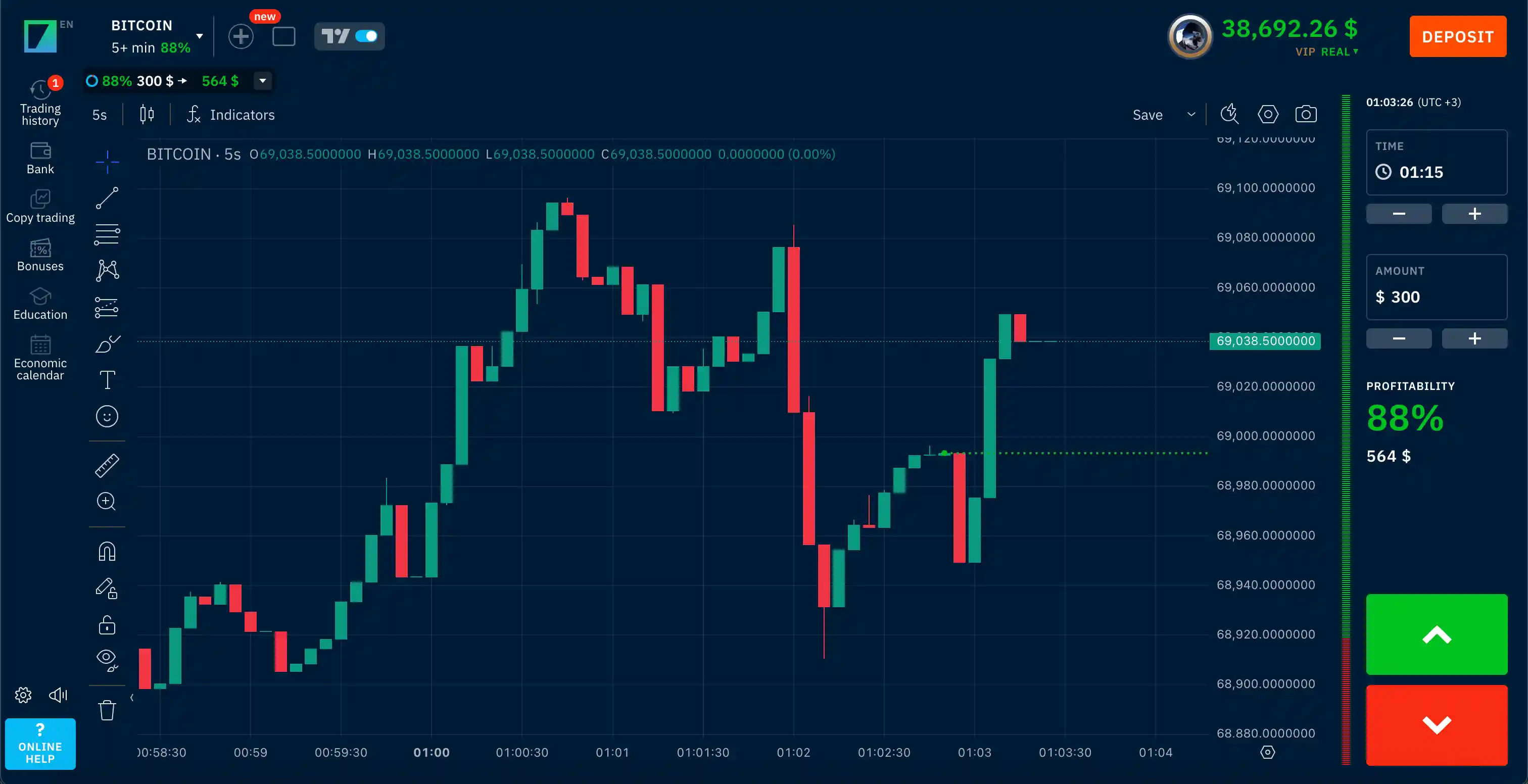
What to do before your first trade on Binarium
Before opening your first trade, it helps to remove the basic confusion. Beginners often lose money not because “the market is against them,” but because the chaos starts before they even enter the terminal.
1) Registration and login
Without this, you simply will not get into the terminal. Go through this step calmly and without unnecessary actions:
- How to register on Binarium and open your account
- How to log into Binarium — both the website and trading platform
If you plan to trade from your phone, this separate guide will help: download the Binarium app or open the mobile version.
2) Why beginners should start with demo
Start with a Binarium demo account, not a real one. On demo, a beginner practices not “luck” but the mechanics: how to choose an asset, set parameters, avoid mixing up buttons, and review the trade afterward. Without that, learning quickly turns into guessing.
If you are starting completely from scratch and still do not fully understand what exactly you are trading, it helps to read binary options in simple terms first and then come back to practice.
3) Understand the platform interface before your first trade
Before your first trade, figure out where everything is in the terminal: asset selection, direction buttons, trade size, time (expiration), and trade history.
To get rid of “platform anxiety” faster, check out the detailed Binarium platform review and the guide on what Binarium is and what to check before you start.
What not to do in your first few days
Here is a short stop-list that genuinely saves beginners:
- do not start right away with a real account “just to test yourself”;
- do not open many trades in a row without reviewing them;
- do not change the trade duration on every attempt;
- do not jump between all assets one after another;
- do not try to recover losses immediately after a losing trade;
- do not trade in a rush “in between other things.”
Micro takeaway: at the start, your goal is not to “make money fast,” but to build a clear and repeatable process.
How to trade on the Binarium platform step by step
This is the core section of the article and the direct answer to the question “how to trade on the Binarium platform.” Below is the beginner’s path from entering the terminal to reviewing the trade.
Table: the beginner’s path from entry to trade review
| Step | Action | What to pay attention to |
|---|---|---|
| 1 | Open the terminal and choose an asset | Stick to 1–2 assets, do not jump around |
| 2 | Decide on the trade direction | Only for a clear reason, not “by eye” |
| 3 | Choose the trade size | Before entry, not after emotions kick in |
| 4 | Choose the trade duration (expiration) | One range for practice |
| 5 | Double-check the parameters | Asset, direction, size, time, and account mode |
| 6 | Review the trade result | Ask 5 questions after every trade |
Step 1. Open the terminal and choose an asset
An asset is the instrument you trade on. Beginners do not need to try to cover everything at once. Choose 1–2 assets to watch, observe them at the same time each day, and do not switch to a different chart every 30 seconds. The more chaos there is at this stage, the worse the whole process works.
Step 2. Decide on the trade direction (for a reason, not “by eye”)
The main beginner mistake is entering based on a feeling: “it looks like it’s going up now.” For learning, it is better to use one simple principle:
No clear reason to enter — no trade.
This immediately reduces random entries and makes trading more deliberate. Your reason should fit into one sentence. If you cannot explain why you are entering, then you have not really made a decision yet.
Step 3. Choose the trade size
Trade size is about controlling risk. This is exactly where most beginners ruin their start. The size is chosen before the entry, not after emotions take over; you should not increase the amount “to win back” the previous loss; during the learning stage, preserving control matters more than “speeding up the result.”
Step 4. Choose the trade duration (expiration)
The trade duration strongly affects the result, but beginners often set it randomly. Then they start feeling like “the strategy doesn’t work,” when the real issue was the parameters. At the beginning, do not change the expiration chaotically from one trade to the next — choose one working range for demo practice and test it under similar conditions.
Step 5. Recheck the parameters and only then open the trade
Before pressing the button, take a short pause and check: asset, direction, trade size, time, and account mode (demo or real). This pause only takes a few seconds, but it removes a huge number of silly mistakes.
Step 6. Review the trade result (mandatory)
After a trade, it is useless to evaluate only “profit/loss.” It is much more useful to evaluate the process. Ask yourself these 5 questions:
- Why did I enter this trade?
- Was my reason for entry solid or forced?
- Did I follow my rules?
- Was the mistake in the idea or in the discipline?
- What should I repeat, and what should I remove in the next session?
Micro takeaway: if you do a review, you are learning. If you just keep clicking, that is not learning — it is noise.
Binarium trading rules for beginners
Basic rules before a trade
- Do not enter without a reason. If there is no reason, there is no trade.
- Do not trade in a rush. If you are distracted, it is better to skip the entry.
- Do not trade “out of boredom.” Not taking a trade is also a normal decision.
- Do not jump between assets. 1–2 assets are better than chaos across the whole terminal.
- Choose the trade size in advance. Do not change the amount “based on your mood.”
Rules during a series of trades
- Limit the number of trades per session. The more chaotic entries you take, the lower the quality of your decisions.
- Do not try to recover after a loss. This is a common cause of sharp mistakes.
- Take a pause after emotions. Irritation, anger, and rushing lead to weak entries.
- Do not change the rules on the fly. If you are testing one scenario, test that scenario — not everything at once.
Rules after the session
- Review the trades, not just the result.
- Write down repeating mistakes.
- Stop on time. For a beginner, it is more useful to end the session earlier than to “squeeze the market.”
How does it look in practice? Watch the video of how I trade together with the members of our portal ⬇️
Here is an example of one of my trading sessions. You can watch how I trade in LIVE mode. Every day, I run two trading sessions — a daytime one at 12:00 and an evening one at 18:00 Moscow time. If you want to join the group where I publish signals for readers of the portal, message me on Telegram — I will give you access for free (there are no paid access levels or VIP groups). Also check out the Live Signals section on our website.
What time is best for trading on Binarium
This is a popular question, but the honest answer is: there is no universal “best time” for everyone. Different assets behave differently, beginners and experienced traders have different levels of control, and it is not only the time of day that matters, but also the condition of the market.
What matters more than “magic hours”
For a beginner, it is more useful to focus on these things: whether you can concentrate calmly, whether you have time not only to trade but also to review your trades, whether the market is understandable at that moment or looks choppy, and whether you are trading according to your plan rather than your emotions.
How to choose your own trading time (practically)
- Pick 1–2 time windows for demo practice.
- Run several calm sessions in each window.
- Track not only the result but also the quality of your entries.
- See where you feel less rushed and more disciplined.
- Keep not the time “when you got lucky once,” but the time when you actually trade by the rules.
Table: how a beginner should choose trading time
| Criterion | Good sign | Bad sign |
|---|---|---|
| Concentration | Calm environment, no distractions | Trading “in between things,” on the go |
| Time for review | You have 10–15 minutes after the session | You have to run off immediately, no review |
| Market | Clear movement, trend or range | Choppy, chaotic chart |
| Emotions | Calm state, no rushing | Irritation, fatigue, gambling mindset |
Micro takeaway: the best time for a beginner is not some “secret hour,” but the period when you can trade calmly and follow your rules.
Binarium: how beginners should trade properly
This question is not solved by one “strategy.” It is solved by the way you work.
A simple beginner mode at the start
- start with a demo account;
- choose 1–2 assets;
- use one learning entry scenario;
- limit the number of trades per session;
- review each session afterward;
- do not switch to real trading just because of one good streak.
How many trades a day should a beginner take?
There is no “magic number.” The main rule is: less, but more deliberate. If you opened a lot of trades and cannot explain any of them, that is not training.
When to move from demo to a real account
It makes sense to move on when you understand the sequence of actions on the platform, do not confuse trade parameters, know how to stop, keep notes on your trades, and follow your rules instead of changing them emotionally.
If you plan to use a real account, study how to pass Binarium verification without unnecessary mistakes in advance so it does not slow the process later. And do not forget to enter the promo code TREND when depositing — it will double your first deposit.
How to trade on Binarium profitably: an honest answer without promises
No one can guarantee a result, but you can improve the quality of your trading and remove the typical causes of losses. For a beginner, that is already a big step — first learning not to lose money because of chaos, and then improving the quality of your entries.
What really affects results over time
For a beginner, it is more useful to look not at simple “profit/loss,” but at the quality of the process: whether the entries had a clear reason, whether the trade size was respected, whether there were attempts to revenge trade, whether you reviewed the session afterward, and how many trades were chaotic. That is how you will see progress even when the result of individual trades is still noisy.
What most often gets in the way of profitability
- the desire to quickly win back a loss;
- chaotic entries without a reason;
- trading “out of boredom”;
- lack of demo practice;
- trying to trade like an experienced trader right away.
If you use additional tools, treat them as a supplement, not a replacement for the basics: free Binarium signals on Telegram, a bot for trading on Binarium. First comes understanding the platform, rules, and discipline. Everything else comes after that.
Micro takeaway: the path to better results starts not with a “secret signal,” but with a normal trading process.
Common beginner mistakes when trading on Binarium
This is the section worth rereading before every session. Most beginner problems are repeated ones.
Table: mistake → why it is dangerous → how to fix it
| Mistake | Why it is dangerous | How to fix it |
|---|---|---|
| Entering without a reason | Random results, impossible to analyze | State your reason in one sentence |
| Increasing the size after a loss | A fast way to blow the deposit | Use a fixed size during the learning stage |
| Chaotic expiration changes | Impossible to understand what works | Use one range for demo testing |
| Jumping between assets | No observation, just chaos | Stick to 1–2 assets at first |
| No review | Repeating the same mistakes again and again | Ask 5 questions after every trade |
| Emotional trading | Weak entries, broken rules | Take a pause after an emotional moment |
A simple practice trading scenario (for training, not a “holy grail”)
To avoid drowning in dozens of strategies, a beginner is better off taking one learning scenario and practicing the process. That is more useful than searching for a new “magic system” every day.
The basic logic of a learning scenario
- You choose one asset.
- You wait for a clear situation on the chart.
- You enter only if you can explain the reason for entry.
- The trade size is set in advance.
- The trade duration is not chosen randomly.
- After the result, you do a review.
This is not a “secret strategy,” but a learning template that helps a beginner understand the process itself: see the reason for entry, set the parameters in advance, and honestly review the result.
Mini case of a practice trade (an example to understand the process)
This is not a “signal,” but an example of how to think during the learning process:
- Step 1. You choose one asset in advance and watch only that asset.
- Step 2. A clear situation appears on the chart for you (not a chaotic section).
- Step 3. You formulate the reason for entry in one sentence.
- Step 4. You set the trade size and time in advance.
- Step 5. You double-check the parameters and only then open the trade.
- Step 6. After the result, you write down: whether the reason was valid, whether you broke a rule, and what to fix.
The main idea is this: even if a particular trade does not close the way you wanted, you still gain value if you kept your discipline and did a review.
A checklist before and after each trade
You can save this block separately and use it as a mini cheat sheet.
What to check before entering
- Am I in the right mode (demo/real)?
- Which asset did I choose, and why?
- What is my reason for entry?
- What is the trade direction?
- What is the trade size?
- What is the trade duration?
- Am I calm and not rushing?
What to write down after the trade
- Why did I enter?
- Did I follow the rules?
- Was the mistake in the idea or in the discipline?
- What should I repeat next time?
- What should I remove today?
A mini template for a beginner trading session
Before the session: choose a time for calm work, open the right mode (demo/real), set a limit on the number of trades, and remind yourself of the rules (no chasing losses, no rushing).
During the session: work only with 1–2 assets, do not enter without a reason, check the parameters before every trade, and take a pause after emotional moments.
After the session: write down the results and mistakes, note where there was discipline and where there was chaos, and end the session instead of trying to “squeeze the market.”
What else matters before real trading on Binarium
When you move from learning to working with a real account, it is useful to sort out some practical issues in advance:
- How the Binarium promo code works and what to check before entering it — if you are considering bonuses.
- What Binarium is and what to check before you start — so you understand the basics.
- Binarium platform review — so you can navigate the interface faster.
FAQ: how to trade on Binarium — common beginner questions
How do beginners trade on Binarium?
It is better to start with a demo account and a simple step-by-step scenario: asset → direction → amount → trade duration → entry → result review. At the beginning, it is more important to understand the order of actions and learn to follow rules.
How do you trade correctly on the Binarium platform?
“Correctly” means not emotionally. Before every trade, there should be a clear reason for entry, the trade size and time should be chosen in advance, and a short review should follow afterward.
Can you trade on Binarium without experience?
You can start learning, but it is better to begin with demo and not rush into a real account. First, you need to understand the interface and remove chaotic actions.
What is the best time to trade on Binarium?
There is no universal time for everyone. A beginner should choose periods when they can stay calm and focused instead of trading on the run.
How do you trade on Binarium profitably?
Profit cannot be guaranteed. But you can improve the quality of your trading by following risk management, avoiding revenge trading, limiting the number of trades, and reviewing your performance over time.
What are the most important Binarium trading rules?
Do not enter without a reason, do not increase the stake after a loss, do not trade emotionally, and do not open too many trades in a row. For a beginner, that already cuts down on mistakes significantly.
What matters more for a beginner: strategy or discipline?
Both matter, but discipline is usually more important at the beginning. Even a decent idea does not help if a person breaks their own rules.
Do you need verification before learning on demo?
For demo, access to the account and the platform matters more. But if you plan to work with a real account, it is better to study verification in advance so it does not slow the process later.
Conclusion
In practice, every question about trading on Binarium as a beginner comes down to one thing: you do not need a “secret,” you need a clear system of actions.
A solid start looks like this: registration and login → demo account → 1–2 assets → a clear reason for entry → control over size and trade time → result review → discipline instead of emotions.
And if your goal is to understand how to trade more profitably, the most honest path is to stop looking for a “magic button” and build a normal trading process. Start with a Binarium demo account, use the promo code TREND when funding a real account, and move step by step — without rushing and without illusions.
Ready to apply this knowledge in practice?
Fund your Binarium account and use the promo code TREND to get a +100% bonus and test your strategy.