Binary Options in Simple Terms: What They Are and How They Work

Promo code: TREND (+100% on your first deposit)
Binary options look deceptively simple: pick an asset, a time, and a direction — higher or lower — and the result is locked in at expiration. But that very simplicity is what fuels chaos: revenge trading, too many trades back-to-back, and purely emotional entries. Below is a clear breakdown of the mechanics, entry logic examples, and rules that help beginners avoid blowing their account in the first few days.
Quick answer (key takeaways in 20 seconds)
- Binary options are a yes/no trade: you choose an asset, a time, and a direction (higher/lower) upfront.
- The outcome is locked in at expiration: correct forecast — one result; wrong — the other. Trade terms (payout/risk) are set in advance in the terminal and can vary by asset.
- What kills most beginners is not a "wrong strategy" — it's chasing losses / martingale, too many trades in a row, and emotional trading.
- Crypto in binary options is usually harder because of sharp moves — start with calmer assets.
- If you're starting from scratch, read the basics first: what trading is.
- Risk rules without fluff: a concise risk plan.
- If you're testing a real account — do it with limits only. At Binarium on first registration you can activate promo code TREND (bonus on first deposit), but the bonus does not replace a risk plan.
Disclaimer: trading is high risk with no guaranteed income. Full disclaimer — here.
Binary options — what they are in simple terms
A binary option is a bet on the direction of price movement by a set time.
You choose:
- an asset (what you're trading),
- an expiration time (when the result is checked),
- a direction — price will be higher or lower,
- a trade amount (how much you're risking).
At expiration the terminal compares the price to the chosen level and locks in the outcome. So the question "what are binary options really" comes down to the mechanics of higher/lower at a point in time.
"Binaries" and "binary trading" — what they mean
- Binaries — informal slang for binary options.
- Binary trading — another common term for the same thing.
- Binary options trading — also widely used; the meaning is identical (though "options" is the more precise term).
How a binary option works (5 steps)
Here is the basic framework for trading binary options — no jargon:
- Choose an asset (for example, an index, a currency pair, or a cryptocurrency).
- Set the trade amount (this is your risk).
- Choose an expiration — how much time until the result is fixed.
- Click "Higher" or "Lower".
- At expiration the terminal checks whether the condition was met and calculates the result.
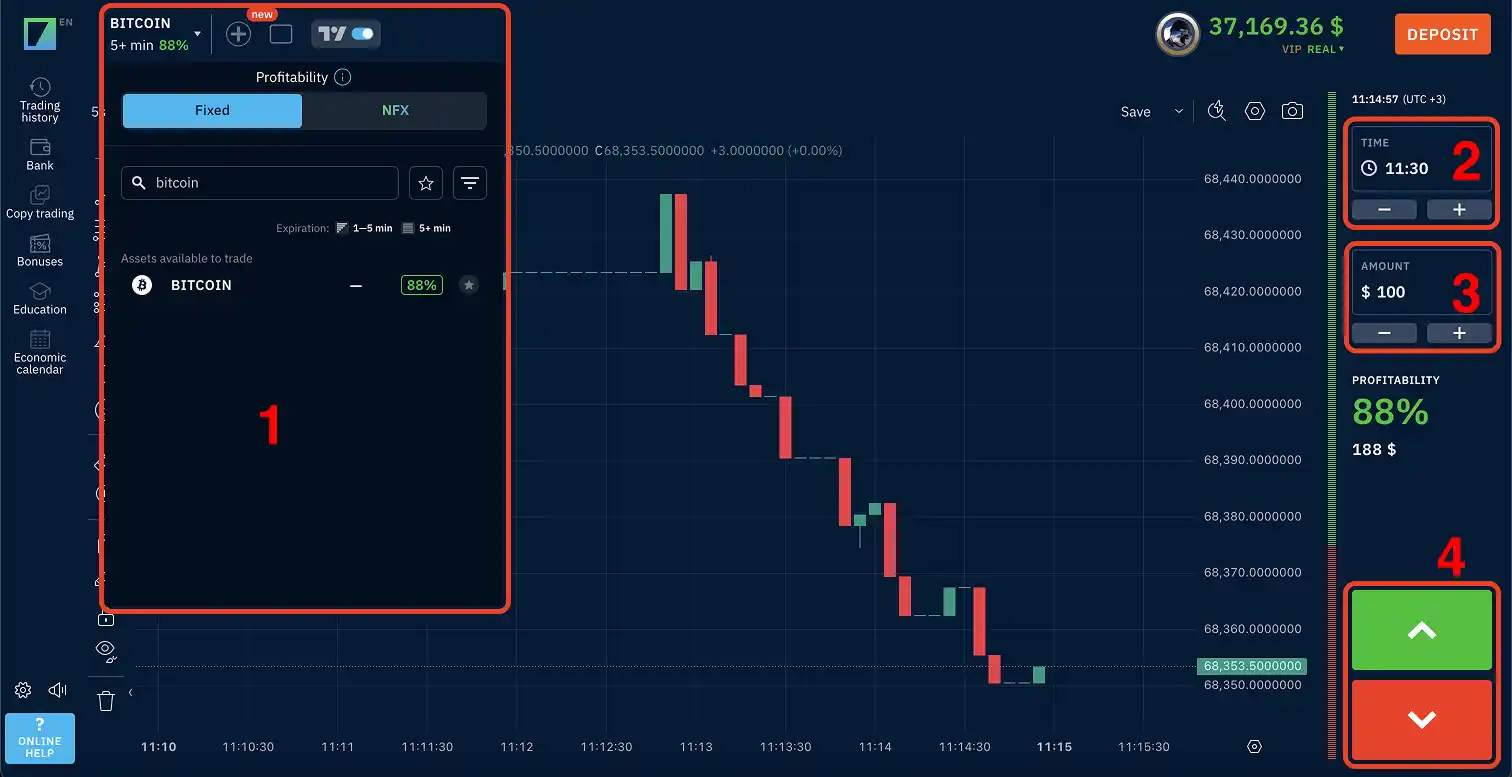
Terms you need to know
| Term | Plain explanation | Where you see it |
|---|---|---|
| Asset | whose price you're forecasting | market selection |
| Expiration | the moment the result is "checked" | trade setup |
| Higher / Lower | your price direction forecast | trade buttons |
| Volatility | how sharply price moves | especially on crypto |
| Setup | entry conditions ("why I'm opening this trade") | your strategy |
| Overtrading | too many trades back-to-back | beginner mistake |
| Chasing / Martingale | "I'll double up after a loss" | the main trap |
| Risk management | rules for controlling losses | your plan |
Binary trade examples (1–2 illustrative scenarios)
Important: these are not "money-making recipes" — they illustrate entry logic and what to record in your trade journal.
Example 1: trend entry (simple idea)
- The chart shows price moving in one direction (let's say an uptrend).
- You don't click on impulse — you wait for the move to be confirmed.
- You pick an expiration that matches your timeframe, not one chosen at random.
- You click "Higher" and log in your journal: what you saw, why you entered, what you did wrong.
Example 2: level entry
- There is a zone from which price has reversed before.
- You wait for price to approach again and confirm a reaction.
- You open the trade strictly according to your rule — and record the result in your journal.
If you want a more systematic approach to analysis and setups, check out the Strategies & Practice section.
Binary options on crypto: what changes
Questions like "binary options on cryptocurrency" usually boil down to why crypto trading feels "more extreme".
Why crypto is harder for beginners
- Sharp moves: price can jump quickly and unpredictably.
- News/impulses: crypto often reacts erratically.
- Psychology: the speed of moves makes it easy to start chasing and open 10 trades in a row.
How to reduce risk on crypto
- Take fewer trades per day.
- Trade only one setup.
- After a losing streak — stop and take a break.
- Don't trade "right after news" unless you have a clear plan.
If you're choosing a market to start with, a market comparison is available in this article.
How binary options differ from forex, CFD, and "regular options"
People often confuse the word "option", so here's a quick breakdown:
| Instrument | Core concept | Key complexity | Beginner risk |
|---|---|---|---|
| Binary options | higher/lower by a point in time | yes/no psychology | high with no plan |
| CFD / forex | size of the move and position management matter | position control | high with leverage |
| "Regular" options | more complex pricing/premium logic | math/terminology | high without fundamentals |
If you want to understand "broker vs platform", here's the basics: broker intermediary guide.
"How to make money with binary options" — honest and no promises
When someone asks "what are binary options and how do you make money", they're usually looking for a "quick way". In reality it all comes down to discipline: a risk plan, a repeatable entry logic, and statistics.
What a beginner actually controls
- the risk size per trade,
- the number of trades per day,
- a stop rule after a losing streak,
- trading only by setup,
- a trade journal.
On psychology and why emotions drain your account: a no-fluff breakdown.
On FOMO (jumping in "because everyone else already made money"): what is FOMO in trading.
If you decide to try a real account with a broker, pick the most straightforward approach possible: minimum amounts, fixed limits, and zero chasing. To get started at Binarium, many traders use promo code TREND — but the priority is following your risk rules (not the bonus).
10 beginner rules to protect your deposit (checklist)
- One asset to start.
- One setup (one entry logic).
- A daily trade limit.
- No chasing / martingale.
- Stop after a losing streak (pause + review).
- Don't trade when angry, tired, or running on adrenaline.
- Demo — for discipline, not for "gambling".
- A trade journal is mandatory.
- Don't buy "guaranteed signals".
- If you can't stop yourself — this format is probably not for you.
Top beginner mistakes (and what to do instead)
| Mistake | Why it's dangerous | What to do instead |
|---|---|---|
| Chasing / martingale | wipes the account fast | loss limit and a break |
| Overtrading | fatigue → mistakes | daily trade limit |
| Strategy hopping | no statistics, pure chaos | one setup for 1–2 weeks |
| Emotional trading | random entries | entry checklist |
| "Signals" without understanding | dependency and account blowup | learn the basics + keep a journal |
Risk plan without fluff: risk management framework.
How to start more safely: demo → small real → discipline
A sensible progression if you still want to give it a try:
- Demo: learn the interface and the rules, without rushing.
- Minimum real: test your psychology and discipline.
- Only then think about increasing amounts — if you're genuinely following the rules.
If you move to a minimum real account at Binarium, promo code TREND can be activated at registration. But I'll repeat the key point: limits and a journal matter more than any bonus.
Trade journal template
| Date | Asset | Expiration | Setup (why I entered) | Result | Mistake | Takeaway |
|---|---|---|---|---|---|---|
| 2026-03-06 | BTC/USD | 5 min | Trend entry after a pullback + confirmation | Loss | Entered too early without candle confirmation | Wait for confirmation, don't rush |
Example of a single journal entry (no "golden percentages"):
"Entered on the trend. Result: loss. Mistake: entry without confirmation. Takeaway: wait for the signal, don't rush."
Safety: red flags (scammers and fakes)
If someone promises you:
- "guaranteed income", "100% strategy", "we'll recover your losses" — it's almost always a scam.
If they ask for:
- passport/card details via messenger,
- remote access installation (AnyDesk/TeamViewer),
- "a withdrawal fee transferred to a card" — close the conversation and walk away.
If you're choosing a platform and a deposit route, use a safe scenario: Binarium getting-started guide.
Conclusion
Binary options are higher/lower trades by a point in time. The format looks simple, but the risk is high because of the yes/no psychology and beginners' habit of "chasing losses".
If you still want to give it a try:
- start with demo,
- pick one setup,
- set limits,
- keep a journal,
- avoid crypto at the start if you're impulsive.
Full disclaimer: here.
FAQ
1) What are binary options in simple terms?
It's a trade format where you choose higher/lower and an expiration time. The result is locked in at expiration, so it's important to understand the risk upfront and avoid trading chaotically.
2) What is a binary option explained simply?
It's a forecast of the price direction over a set period. You don't "buy the asset" — you bet on whether the price will be higher or lower at expiration.
3) What do "binaries" and "binary trading" mean?
These are informal names for binary options. "Binary options trading" is also a common phrase — same meaning.
4) Can you make money with binary options?
In theory yes, but it's not "fast money". You need a risk plan, discipline, and trade statistics. Without them, losses are the more likely outcome.
5) Why are binary options on crypto harder?
Crypto moves sharply and impulsively, which raises the chance of random price swings and emotional mistakes.
6) How do binary options differ from forex/CFD?
In binary options the result is yes/no at a point in time; in CFD/forex the size of the move and position management are what matter. Beginners need a risk plan in both cases.
7) What is expiration?
It's the moment when the trade result is fixed. Choose your expiration to match your entry logic and timeframe — not at random.
8) What is the biggest beginner mistake?
Chasing losses (martingale) and trading without breaks. This drains a deposit faster than anything else.
Ready to put your knowledge into practice?
Fund your Binarium account and use promo code TREND to get a +100% bonus and test your strategy.