USDT Explained Simply: A Complete Beginner-Friendly Guide for Trading

Promo code: TREND (+100% on your first deposit)
If you're looking into trading or remote income in crypto, you'll run into the USDT abbreviation everywhere — in beginner guides, on exchanges, and in broker deposit options. But what is USDT in plain English? Is it a dollar? A cryptocurrency? And why do traders park money in it instead of Bitcoin? Let's break it down in a human way: how Tether works, where to buy it, and why it can be useful when you're just starting to trade.
USDT in Simple Terms: The Short Version
USDT is a cryptocurrency whose price is pegged to the US dollar at roughly 1:1. One USDT is almost always equal to one dollar, give or take a couple of cents. The token is issued by Tether, which is why people also call it “USDT,” “Tether,” or simply “the stablecoin.”
The easiest way to picture it is this: USDT is a dollar that lives not in a bank, but in a crypto wallet. You can buy it, send it to a friend on the other side of the world in a few minutes, swap it for Bitcoin, or hold it as savings — just without a bank account or a card.
USDT stands for US Dollar Tether. The word “tether” literally means a link or a peg, which matches the idea perfectly: the USDT token is tied to the dollar by a “rope” held by the issuing company. So when people search for “what does USDT mean,” this is the answer.
By the way, in Russian-speaking communities this token is spelled in all kinds of ways because people write it phonetically or with typos. No matter how it is written, it is still the same asset: the Tether USDT stablecoin.
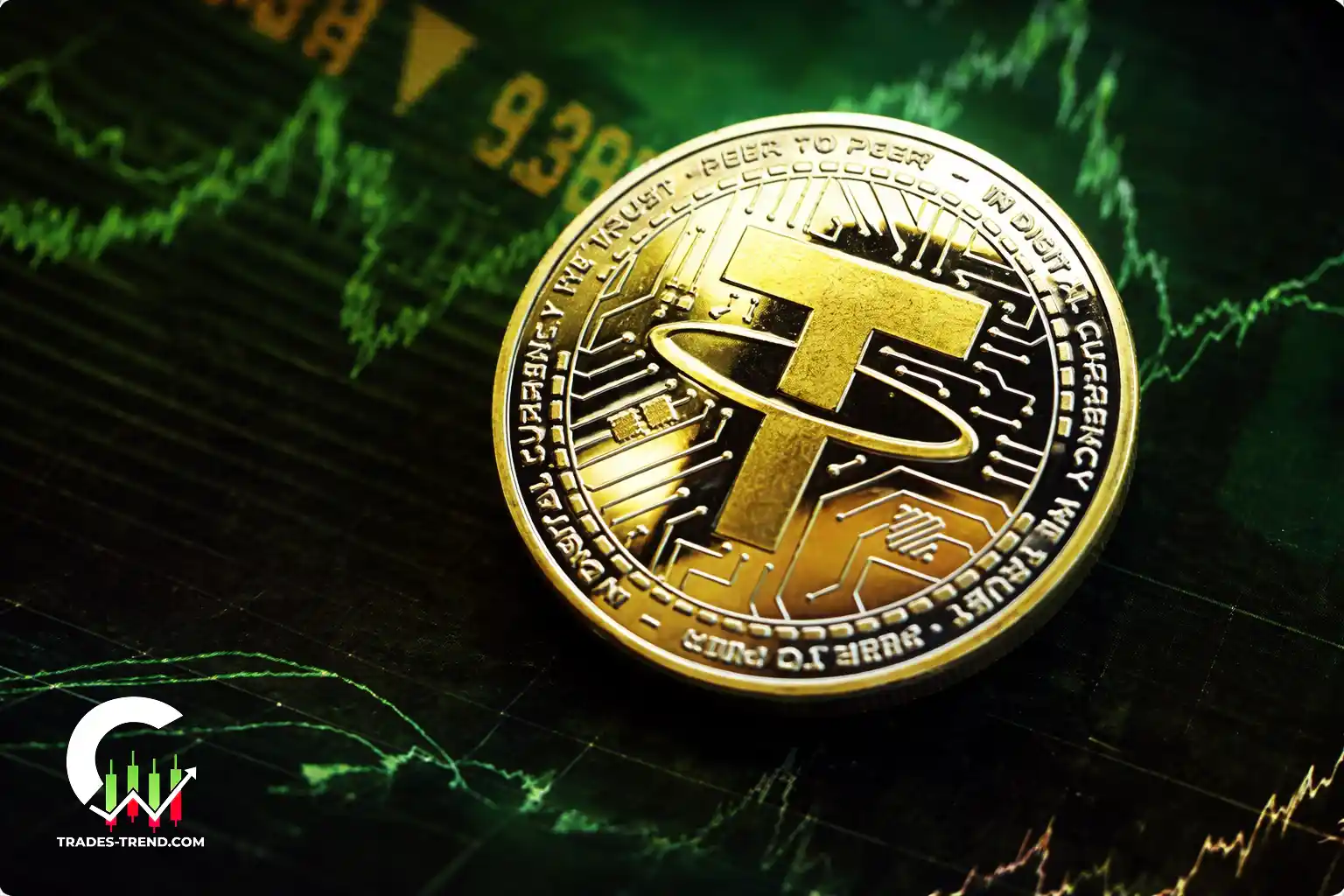
Are USDT and Tether the Same Thing?
Basically yes, but there is a nuance. Tether is the name of the project and the company that issues the token. USDT is the ticker — the short market symbol of the token itself, just like BTC for Bitcoin or ETH for Ether.
When someone says “I bought Tether” or “I sent a hundred Tethers,” they mean USDT. On exchanges and in wallets, you will usually see the USDT label rather than Tether. So questions like “USDT vs Tether” have a simple answer: it is the same asset.
How USDT Works: Where the “Digital Dollar” Comes From
A lot of beginners get stuck on one thing: how can a cryptocurrency like USDT even exist if it barely moves in price? The mechanics are actually simple.
Who Issues USDT
Behind USDT stands Tether Limited, the sole issuer of the token. It decides when to mint new USDT and when to burn part of the supply. That is one of the biggest differences from Bitcoin, which has no owner. Tether is a centralized project backed by a real company with management, reporting, and a corporate structure.
You can check up-to-date information about the company structure and jurisdiction on the official website at tether.to — those details are updated from time to time.
What Backs USDT
The core principle is simple: for every USDT issued, Tether is supposed to hold reserves worth about one dollar. These reserves may include cash, short-term US Treasury bills, deposits, and other assets. The company regularly publishes reserve reports, where you can see what the USDT token is backed by at the moment.
Why USDT Is Almost Always Worth About $1
This works because of two mechanisms. The first is the backing itself: as long as real assets stand behind the token, the market believes in the peg. The second is arbitrage: as soon as the price drifts away from the dollar, traders buy or sell the token and push it back toward parity. Arbitrage traders profit from price differences across platforms, and their activity helps keep the peg tighter than any promise alone.
Here is what that looks like step by step:
- A user brings one dollar into the Tether system.
- The company issues one new USDT and sends it to the user’s wallet.
- The token moves freely across the blockchain — it can be transferred, exchanged, or sold.
- When someone brings USDT back and wants dollars, the token is burned and the dollars are returned.
USDT, the Dollar, and Bitcoin: What’s the Difference?
To avoid confusion, let’s compare three things people often mix together: a regular bank dollar, USDT, and Bitcoin. This also answers the question “what kind of currency is USDT?” Formally it is a cryptocurrency, but economically it behaves much more like a digital dollar.
| Parameter | Dollar (USD) | USDT | Bitcoin (BTC) |
|---|---|---|---|
| Type | Fiat currency | Cryptocurrency (stablecoin token) | Cryptocurrency |
| Issuer | US Federal Reserve | Tether Limited | Decentralized network |
| Price volatility | Low | Minimal (~$1) | Very high |
| Where it is stored | Bank, card, cash | Crypto wallet, exchange | Crypto wallet, exchange |
| Transfer speed | From minutes to several days | A few minutes | From minutes to an hour |
| Works 24/7 | No (depends on banks) | Yes | Yes |
The key idea is simple: Bitcoin can be at forty thousand today, thirty tomorrow, and fifty the day after. USDT, meanwhile, stays close to the dollar. That is the whole point of a stablecoin — to give people in crypto a tool that does not swing wildly. If you make money on Bitcoin, you can move into USDT and sleep better. To understand the broader classification of crypto, check the separate guide on types of cryptocurrencies, and for a beginner breakdown of the “main” coin, read Bitcoin explained simply.
How Much 1 USDT Costs and Why the Price Sometimes Wobbles
The short answer to “how much is 1 USDT?” is simple: one USDT is worth about one US dollar. In practice, you may see 0.998, 1.001, or sometimes 0.995 — and that is normal.
Why does it move at all? First, different exchanges can show slightly different prices because of real-time supply and demand. Second, large buy or sell orders can temporarily shake the price — but arbitrage traders usually pull it back toward the dollar very quickly.
For a beginner, the main rule is this: if you see USDT priced at 1.05 or 0.92, that is an anomaly, and it is usually better to wait until the price normalizes. A healthy range is 0.99–1.01.
USDT Networks: TRC20, ERC20, and Others
This is where beginners lose money most often. The same USDT token can exist on different blockchain networks. If you send it through a network the recipient does not support, the money is usually gone with little or no chance of recovery.
Read this section carefully. Seriously.
Imagine USDT is a package and the networks are different delivery services. The package is the same, but one service uses one route and another uses a different route. If you ship through Tron while the recipient expects Ethereum, nothing arrives at their door.
The most common networks where USDT exists are:
| Network | Description | Fee | Best for |
|---|---|---|---|
| TRC20 (Tron) | The most popular USDT network | Very low (~$1) | Beginners and frequent transfers |
| ERC20 (Ethereum) | Ethereum’s base network | High (often $5–20+) | People using DeFi |
| BEP20 (BNB Chain) | Binance ecosystem network | Low | Binance users |
| Polygon / Solana, etc. | Newer networks with fast transfers | Minimal | Advanced users |
⚠️ Key rule
Before every USDT transfer, check which network the recipient supports — exchange, swap service, or wallet. Select that exact network. Send it to the wrong one, and in 99% of cases the coins are not coming back.
Where and Why USDT Is Used
USDT on an Exchange: What It Means
When you open any major exchange, you will notice that most trading pairs are listed as “coin/USDT”: BTC/USDT, ETH/USDT, SOL/USDT, TON/USDT. That means USDT is the base currency used to trade almost everything else. This is why, in simple terms, USDT on an exchange is a trader’s “working dollar” — the unit used to buy and sell other cryptocurrencies.
Here is how to read a pair like BTC/USDT: if BTC/USDT is priced at 40,000, that means one Bitcoin costs 40,000 USDT, or roughly 40,000 dollars. When you buy Bitcoin, you pay USDT. When you sell Bitcoin, you receive USDT back.
Why a Beginner Trader Might Use USDT
Here are two real-life scenarios — pick the one that feels closer to your starting point.
Scenario 1. Binary options trading. You register with a broker that accepts USDT deposits. You buy USDT through P2P on a large exchange, transfer it to your broker account, and start trading right away without bank transfers or waiting lines. When you take profit, you withdraw back into USDT and, if you want, swap it into your local currency later. It is faster, cheaper, and works from almost any country. For example, Binarium accepts USDT through major networks, and the promo code TREND gives you +100% on your first deposit. If you want to see how trading on that platform works, check the guide How to Trade on Binarium as a Beginner, and if you want the basics first, read binary options explained simply.
Scenario 2. Classic crypto trading. You buy 500 USDT through P2P. You spot an entry on Bitcoin and enter the BTC/USDT pair. A week later you close the trade in profit and receive USDT back — only now you have more of it. Then you either look for the next trade or cash out and convert it into your local currency.
In both cases, USDT works as the trader’s operating currency: you store money in it between trades, fund accounts with it, and use it to move into other assets. If you still have not decided which market to start with, check the comparison guide Which Market to Choose When Starting Out — it compares crypto, Forex, options, and stocks.
Here is a practical list of why a beginner may want USDT:
- to store profits without major price swings;
- to enter and exit exchange trades quickly;
- to move money between exchanges and wallets;
- to buy other cryptocurrencies — most trading pairs are quoted against USDT;
- to cash out through P2P to a bank card;
- to send cross-border transfers more cheaply than through a bank;
- to fund a broker account without relying on banks.
USDT, USDC, DAI: How Stablecoins Differ
USDT is not the only stablecoin on the market. Here we also cover the basic question behind terms like USDC or USD Coin — these are its main competitors.
| Parameter | USDT | USDC | DAI |
|---|---|---|---|
| Issuer | Tether Limited | Circle | MakerDAO (decentralized) |
| Peg | To the dollar 1:1 | To the dollar 1:1 | To the dollar ~1:1 |
| Backing | Reserves (cash + bonds) | Reserves (cash + US Treasuries) | Crypto collateral in a smart contract |
| Regulation | Offshore jurisdiction | US, stricter | Decentralized |
| Liquidity | Highest on the market | Second by volume | Lower volume |
For a beginner, the difference between USDT and USDC usually is not critical — both are pegged to the dollar and can be converted into each other without much trouble. DAI works differently: instead of a company, it is backed by crypto collateral. In short, for your first experience, use whichever stablecoin your broker or exchange supports. The rest can wait.
As for lesser-known tokens like USDR, that is a different stablecoin entirely and not part of the Tether ecosystem. We will not go deeper into it here to avoid mixing things up.
How to Buy and Store USDT
Where to Buy USDT
- Centralized exchanges (Binance, Bybit, OKX, and others) — the most popular option. You register, fund your account, and buy through P2P or by card depending on what is available in your region.
- P2P marketplaces — buying directly from another person through an exchange escrow system.
- Swap services — websites where people exchange local currency or other assets for USDT. The key is to choose verified services listed on trusted rating aggregators.
Where to Store USDT
- On an exchange. Convenient, but you depend on the exchange. Fine for smaller sums you actively trade with.
- In a hot wallet. A mobile app or a browser extension. Convenient and usually a bit safer than leaving everything on an exchange.
- In a cold wallet. A separate device that is not permanently connected to the internet. The safest option for larger amounts.
Risks: Can You Lose Money with USDT?
Now honestly, without rose-colored glasses: USDT is not an insured bank deposit. There are real risks, and it is better to know them in advance.
De-pegging risk. The USDT price can temporarily move away from the dollar. In the past, there have been episodes when the token slipped to 0.95–0.97 and then returned. For short-term storage, this is usually not critical, but it is something to remember.
Issuer risk. Everything depends on Tether Limited. If something serious happens to the company, the token itself may come under pressure.
Exchange or wallet risk. If you keep USDT on an exchange, you are effectively trusting that platform with your money. Exchanges can be hacked, accounts can be frozen, and withdrawals can be restricted. Larger amounts are safer in your own wallet.
Transfer mistake risk. We already talked about this: wrong network, lost coins. It is one of the most common ways beginners lose money.
Regulatory risk. Different countries treat crypto differently, and the rules change. It is always worth checking the law in your own jurisdiction at the time you make decisions.
If you want to understand how to manage risk in trading and avoid blowing your deposit in your first trades, read the separate guide on money management and capital control.
Checklist and Common Beginner Mistakes
Checklist: what to verify before your first USDT purchase. Save this list — it helps remove most beginner mistakes:
- ☐ I understand that USDT is not a bank dollar, but a blockchain token
- ☐ I chose which network I will receive USDT on (TRC20, ERC20, or another)
- ☐ I checked that both sender and recipient are using the same network
- ☐ I know what transfer fee will apply
- ☐ I chose where to store the coins — on an exchange or in my own wallet
- ☐ If I chose a wallet, I wrote down the seed phrase and stored it safely
- ☐ I am starting with a small amount to practice
- ☐ I checked the tax rules in my country
Common beginner mistakes:
- Sending USDT on the wrong network. A classic. The recipient expects TRC20, the sender uses ERC20, and the coins disappear. Always verify the network on both sides.
- Buying USDT through a shady swap service. You may end up with either a bad rate or outright fraud. Use services listed on reputable aggregators.
- Mixing up USDT and USDC. The exchange may accept it to a different address or delay processing — annoying at best, expensive at worst.
- Keeping everything on an exchange. The exchange shuts down, freezes the account, or asks for painful verification — and suddenly your funds are stuck. For larger amounts, use your own wallet.
- Not double-checking the recipient address. One wrong character and your money goes into the void. Copy addresses instead of typing them manually, and verify the first and last symbols.
Main Takeaways
- USDT is a cryptocurrency pegged to the US dollar at roughly 1:1.
- It is issued by Tether Limited, and each token is backed by reserves.
- USDT stands for US Dollar Tether. Tether and USDT refer to the same asset.
- USDT can exist on different networks (TRC20, ERC20, and others). Send it through the wrong network and you can lose money.
- On exchanges, USDT is the base currency used to trade most other crypto assets.
- The main risks are de-pegging, issuer risk, exchange risk, and transfer mistakes.
- For larger amounts, it is better to use your own wallet rather than leave everything on an exchange.
What to Do Next
If you are just getting into crypto and trading, here is a logical order of steps:
- Read about types of cryptocurrencies so you understand how USDT differs from Bitcoin, altcoins, and meme coins.
- Choose your starting market — crypto, Forex, options, or stocks.
- Go through the basic guide Trading from Scratch to see how beginners realistically start.
- Understand how to choose a broker and try your first trades on a demo account. If you decide to open a live account on Binarium, do not forget the promo code TREND — it gives you +100% on your first deposit.
USDT is just a tool. By itself, it will not create profit or loss. What matters is how you use it in trading.
Frequently Asked Questions (FAQ)
What does USDT stand for?
USDT stands for US Dollar Tether. The word “tether” means a link or peg, and that matches the token’s core idea exactly: it is tied to the US dollar at roughly 1:1.
Are USDT and Tether the Same Thing?
Basically yes. Tether is the name of the issuing company and the project itself, while USDT is the ticker of the token it issues. When people say they bought Tether, they usually mean USDT.
Is USDT a Real Dollar?
No. USDT is a cryptocurrency pegged to the dollar, not a dollar itself. You can only store it in a crypto wallet or on an exchange. In value terms, 1 USDT is almost always close to 1 US dollar.
Why Is USDT Worth About 1 Dollar?
Because of two things: the issuer holds reserves backing each token, and arbitrage traders help keep the market price near the peg. Fluctuations in the 0.99–1.01 range are normal.
What Happens If You Send USDT on the Wrong Network?
In most cases, the coins will be lost or get stuck, and recovering them is nearly impossible. Before every transfer, check which network the recipient supports.
How Is USDT Different from USDC?
Both are dollar-pegged stablecoins, but they are issued by different companies. USDT comes from Tether Limited, while USDC comes from Circle. For beginners, the difference is usually not critical.
Can You Lose Money with USDT?
Yes. There are real risks: temporary de-pegging, problems with the issuer or exchange, and transfer mistakes. USDT is a practical tool, not a risk-free deposit.
Is USDT a Scam?
No. USDT is one of the most popular and liquid assets in crypto, with billions of dollars in daily turnover. There have been questions about reserve transparency, but no major exchange or regulator treats it as a scam.
Ready to put this into practice?
Fund your Binarium account in USDT and use the promo code TREND to get a +100% bonus and test your strategy.